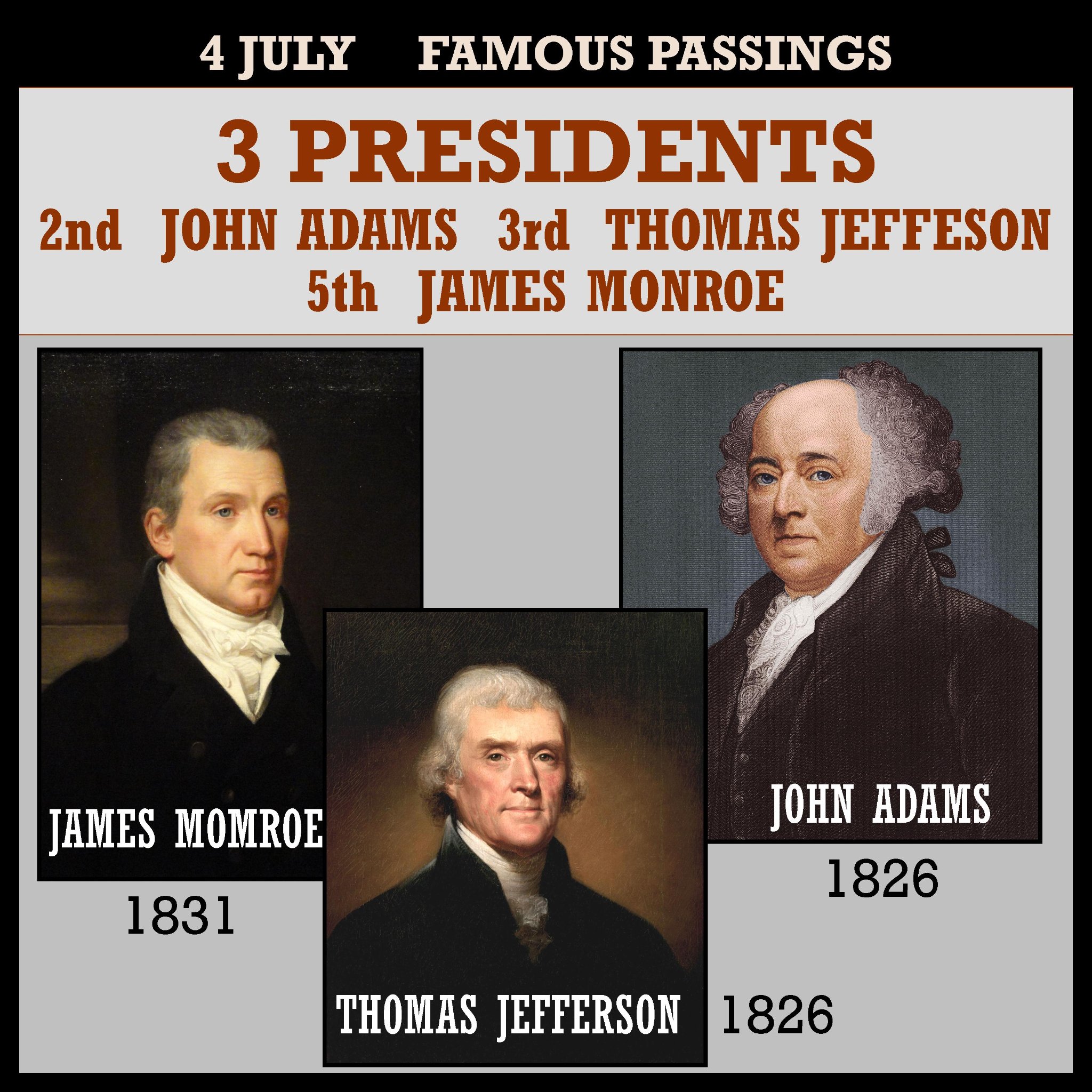
John Adams (October 30, 1735 â July 4, 1826) was an American statesman, attorney, diplomat, writer, and Founding Father who served as the second president of the United States from 1797 to 1801. Before his presidency, he was a leader of the American Revolution that achieved independence from Great Britain and during the war, served as a diplomat in Europe. He was twice elected vice president of the United States, serving from 1789 to 1797 in a prestigious role with little power. Adams was a dedicated diarist and regularly corresponded with many important contemporaries, including his wife and adviser Abigail Adams as well as his friend and rival Thomas Jefferson.
Thomas Jefferson (April 13, 1743 â July 4, 1826) was an American statesman, diplomat, lawyer, architect, philosopher, and Founding Father who served as the third president of the United States from 1801 to 1809. He was previously the second vice president of the United States under John Adams and the first United States secretary of state under George Washington. The principal author of the Declaration of Independence, Jefferson was a proponent of democracy, republicanism, and individual rights, motivating American colonists to break from the Kingdom of Great Britain and form a new nation. He produced formative documents and decisions at state, national, and international levels.
James Monroe (April 28, 1758 â July 4, 1831) was an American statesman, lawyer, diplomat and Founding Father who served as the fifth president of the United States from 1817 to 1825. A member of the Democratic-Republican Party, Monroe was the last president of the Virginia dynasty and the Republican Generation; his presidency coincided with the Era of Good Feelings, concluding the First Party System era of American politics. He is perhaps best known for issuing the Monroe Doctrine, a policy of opposing European colonialism in the Americas while effectively asserting U.S. dominance, empire, and hegemony in the hemisphere. He also served as governor of Virginia, a member of the United States Senate, U.S. ambassador to France and Britain, the seventh Secretary of State, and the eighth Secretary of War.
MILITARY HISTORY SOCIETY OF ROCHESTER
ROCHESTERMILITARY.COM