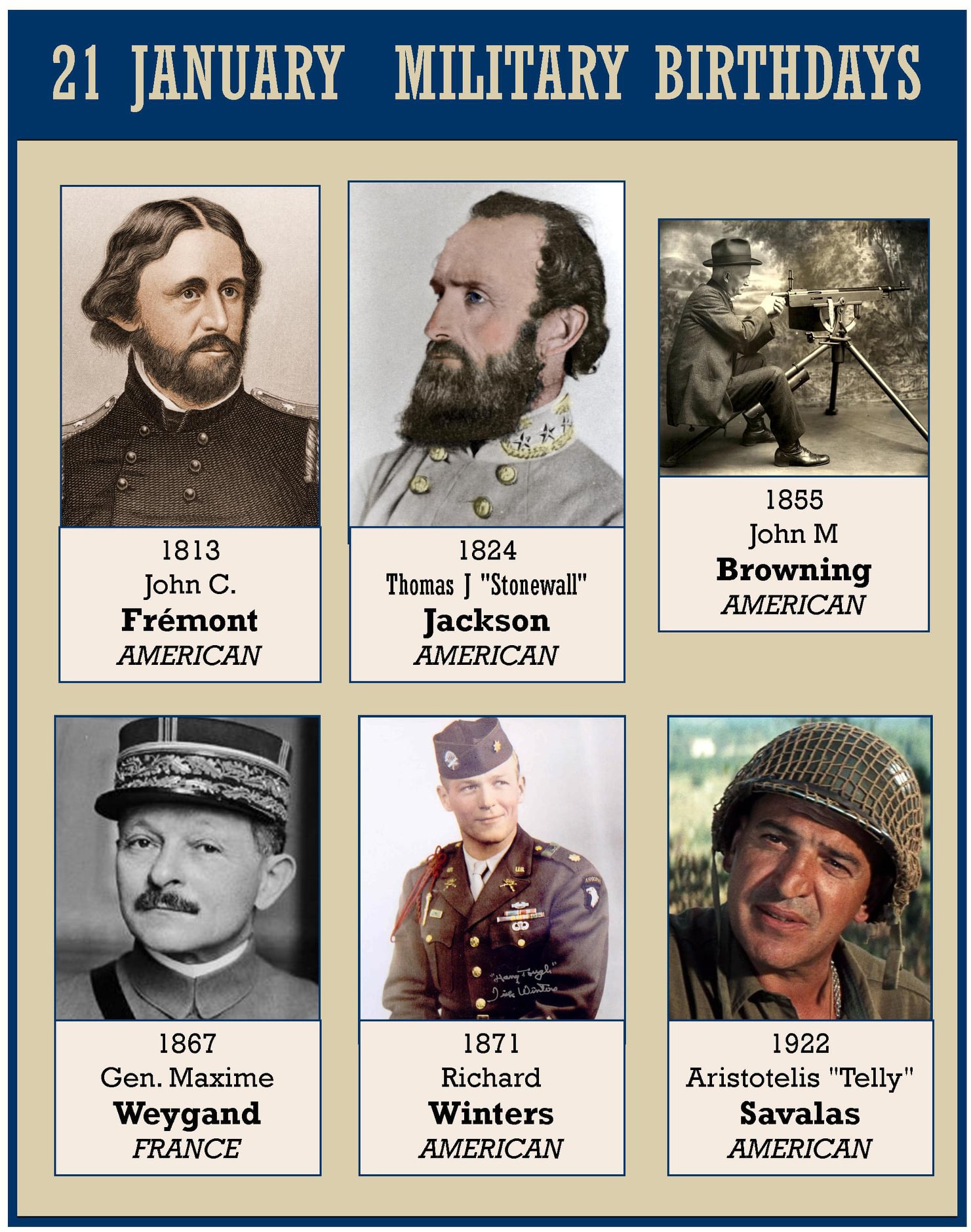
John Charles Frémont, (born January 21, 1813, Savannah, Georgia, U.S.âdied July 13, 1890, New York, New York), American military officer and an early explorer and mapmaker of the American West, who was one of the principal figures in opening up that region to settlement and was instrumental in the U.S. conquest and development of California.
Thomas Jonathan “Stonewall” Jackson (January 21, 1824 â May 10, 1863) served as a Confederate general (1861â1863) during the American Civil War, and became one of the best-known Confederate commanders after General Robert E. Lee. Jackson played a prominent role in nearly all military engagements in the Eastern Theater of the war until his death, and had a key part in winning many significant battles.
John Moses Browning (January 23, 1855 â November 26, 1926) was an American firearms designer who developed many varieties of military and civilian firearms, cartridges, and gun mechanisms â many of which are still in use around the world. He made his first firearm at age 13 in his father’s gun shop, and was awarded the first of his 128 firearm patents on October 7, 1879, at the age of 24.
Maxime Weygand, (born Jan. 21, 1867, Brusselsâdied Jan. 28, 1965, Paris), French army officer who in World War I served as chief of staff under Gen. (later Marshal) Ferdinand Foch and who in World War II, as commander in chief of the Allied armies in France, advised the French government to capitulate (June 12, 1940).
Richard Davis Winters (Band of Brothers) (January 21, 1918 â January 2, 2011), usually known simply as Dick Winters, was an officer of the United States Army and a decorated war veteran. He is best known for having commanded Easy Company (Band of Brothers) of the 2nd Battalion, 506th Parachute Infantry Regiment, part of the 101st Airborne Division, during World War II.
Aristotelis “Telly” Savalas was born on January 21, 1922 in Garden City, New York, the son of Greek immigrants. In 1941, he joined the army and served in World War II, from which he was discharged with a Purple Heart disability.After his release, Savalas attended the Armed Forces Institute where he studied radio and television production. He went on to enroll at Columbia University where he continued his studies in psychology. During the early 1950s, Telly worked for ABC radio as host of the Voice of America.
rochestermilitary.com