JULY 26
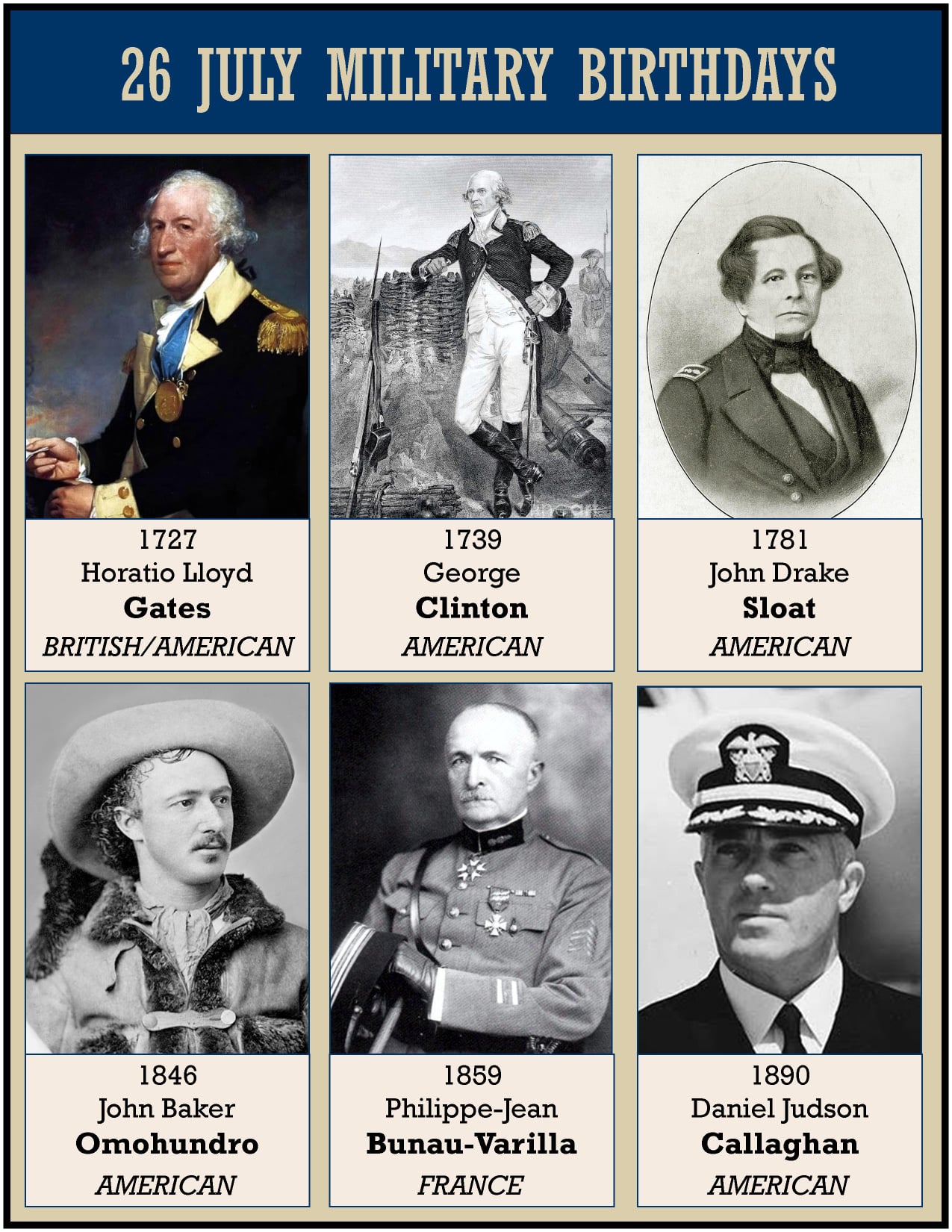
1727 Horatio Lloyd Gates (July 26, 1727 â April 10, 1806) was a British-born soldier who served as a leading American general during the early years of the Revolutionary War. He took credit for the American victory in the Battles of Saratoga (1777) â a matter of contemporary and historical controversy â and was blamed for the defeat at the Battle of Camden in 1780. Gates has been described as “one of the Revolution’s most controversial military figures” because of his role in the Conway Cabal, which attempted to discredit and replace General George Washington; the battle at Saratoga; and his actions during and after his defeat at Camden.
1739 George Clinton (July 26, 1739 â April 20, 1812) was an American soldier and statesman, considered one of the Founding Fathers of the United States. A prominent Democratic-Republican, Clinton served as the fourth vice president of the United States from 1805 until his death in 1812. He also served as governor of New York from 1777 to 1795 and from 1801 to 1804. Along with John C. Calhoun, he is one of two vice presidents to hold office under two presidents.
1781 John Drake Sloat (July 6, 1781 â November 28, 1867) was a commodore in the United States Navy who, in 1846, claimed California for the United States.
1846 John Baker Omohundro (July 26, 1846 â June 28, 1880), also known as “Texas Jack”, was an American frontier scout, actor, and cowboy. Born in rural Virginia, he served in the Confederacy during the American Civil War and, later, as a civilian scout for the US Army during the Indian Wars. Before his untimely death, Texas Jack became a legendary figure in the American Old West as a Western showman performing dramas on the stage throughout the country, and was immortalized in dime novels published around the world.
1859 Philippe-Jean Bunau-Varilla (1859â1940), commonly referred to as simply Philippe Bunau-Varilla, was a French engineer and soldier. With the assistance of American lobbyist and lawyer William Nelson Cromwell, Bunau-Varilla greatly influenced Washington’s decision concerning the construction site for the Panama Canal. He also worked closely with President Theodore Roosevelt in the latter’s orchestration of the Panamanian Revolution.
1890 Daniel Judson Callaghan (July 26, 1890 â November 13, 1942) was a United States Navy officer who received the Medal of Honor posthumously for his actions during the Naval Battle of Guadalcanal. In a career spanning three decades, he served his country in two wars. Callaghan served on several ships during his first 20 years of service, including escort duties during World War I, and also filled some shore-based administrative roles. He later came to the attention of President Franklin D. Roosevelt, who appointed Callaghan as his naval aide in 1938. A few years later, he returned to command duties during the early stages of World War II. Callaghan was killed by an enemy shell on the bridge of his flagship, USS San Francisco, during a surface action against a larger Japanese force off Savo Island. The battle ended in a strategic victory for the Allied side.
MILITARY HISTORY SOCIETY OF ROCHESTER
ROCHESTERMILITARY.COM