June 11
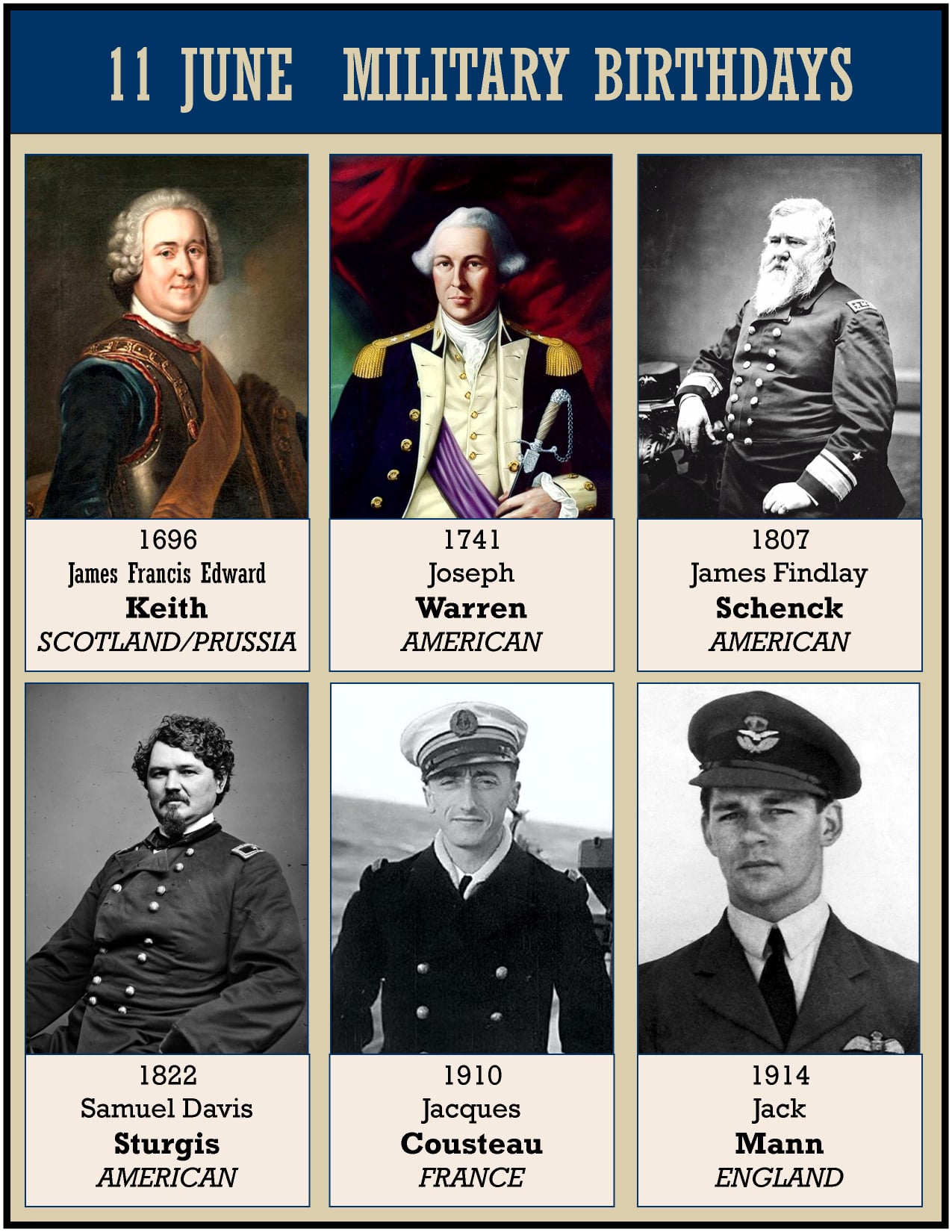
1696 James Francis Edward Keith (in later years Jakob von Keith; 11 June 1696 â 14 October 1758) was a Scottish soldier and Generalfeldmarschall of the Royal Prussian Army. As a Jacobite he took part in a failed attempt to restore the Stuart Monarchy to Britain. When this failed, he fled to Europe, living in France, and then Spain. He joined the Spanish and eventually the Russian armies and fought in the Anglo-Spanish War and the Russo-Swedish War. In the latter he participated in the conquest of Finland and became its viceroy. Subsequently, he participated in the coup d’état that put Elizabeth of Russia on the throne. He subsequently served in the Prussian army under Frederick the Great, where he distinguished himself in several campaigns. He died during the Seven Years’ War at the Battle of Hochkirch. He received the Black Eagle Order and is memorialised on the Equestrian statue of Frederick the Great.
1741 Joseph Warren (June 11, 1741 â June 17, 1775) was an American physician who played a leading role in Patriot organizations in Boston during the early days of the American Revolution, eventually serving as President of the revolutionary Massachusetts Provincial Congress. Warren enlisted Paul Revere and William Dawes on April 18, 1775, to leave Boston and spread the alarm that the British garrison in Boston was setting out to raid the town of Concord and arrest rebel leaders John Hancock and Samuel Adams. Warren participated in the Battles of Lexington and Concord the following day, which are commonly considered to be the opening engagements of the American Revolutionary War. Warren had been commissioned a major general in the colony’s militia shortly before the June 17, 1775 Battle of Bunker Hill. Rather than exercising his rank, Warren chose to serve in the battle as a private soldier, and was killed in combat when British troops stormed the redoubt atop Breed’s Hill. His death, immortalized in John Trumbull’s painting, The Death of General Warren at the Battle of Bunker’s Hill, June 17, 1775, galvanized the rebel forces. He has been memorialized in the naming of many towns, counties, streets, and other locations in the United States, by statues, and in numerous other ways.
1807 James Findlay Schenck (June 11, 1807 â December 21, 1882) was a rear admiral in the United States Navy who served in the MexicanâAmerican War and the American Civil War. His younger brother, Robert C. Schenck, was a Union Army general and a United States Ambassador to Brazil.
1822 Samuel Davis Sturgis (June 11, 1822 â September 28, 1889) was a senior officer of the United States Army. A veteran of the Mexican War, Civil War, and Indian Wars, he attained the rank of Brevet major general.
1823 James Lawson Kemper (June 11, 1823 â April 7, 1895) was a lawyer, a Confederate general in the American Civil War, and the 37th Governor of Virginia. He was the youngest brigade commander and only non-professional military officer in the division that led Pickett’s Charge, during which he was severely wounded.
1910 Jacques-Yves Cousteau, AC (11 June 1910 â 25 June 1997)[1] was a French naval officer, explorer, conservationist, filmmaker, innovator, scientist, photographer, author and researcher who studied the sea and all forms of life in water. He co-developed the Aqua-Lung, pioneered marine conservation and was a member of the Académie Française. In 1930, he entered the Ãcole navale and graduated as a gunnery officer. However, an automobile accident, which broke both his arms, cut short his career in naval aviation. The accident forced Cousteau to change his plans to become a naval pilot, so he then indulged his passion for the ocean.
1914 Jackie Mann, CBE, DFM (11 June 1914 â 12 November 1995) was a Royal Air Force fighter pilot in the Battle of Britain, who in later life was kidnapped by Islamists in Lebanon in May 1989 and held hostage for more than two years.
MILITARY HISTORY SOCIETY OF ROCHESTER
ROCHESTERMILITARY.COM