JUNE 17
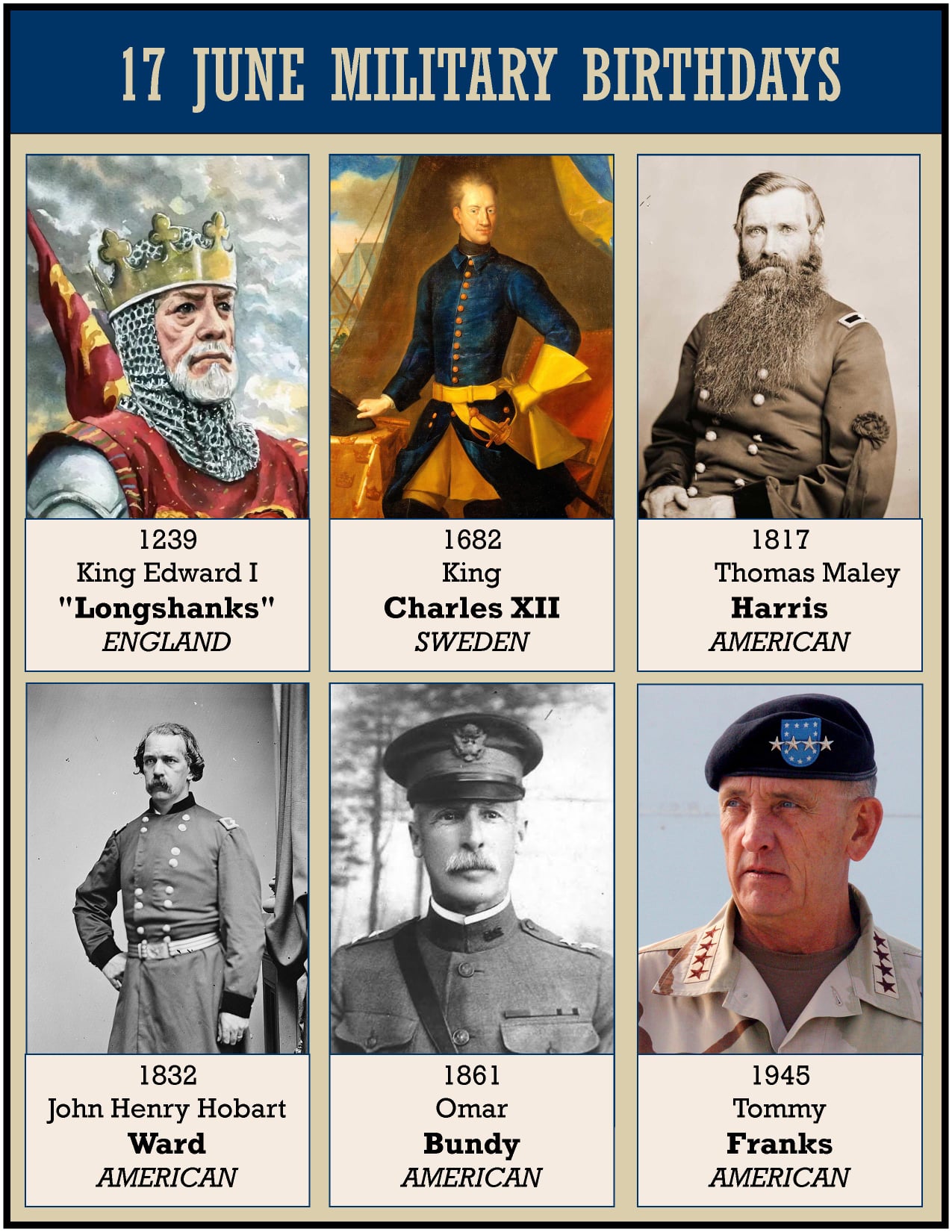
1239 Edward I (17 June 1239 â 7 July 1307), also known as Edward Longshanks and the Hammer of the Scots (Latin: Malleus Scotorum), was King of England from 1272 to 1307. Before his accession to the throne, he was commonly referred to as The Lord Edward.[1] The first son of Henry III, Edward was involved from an early age in the political intrigues of his father’s reign, which included an outright rebellion by the English barons. In 1259 he briefly sided with a baronial reform movement, supporting the Provisions of Oxford. After reconciliation with his father, however, he remained loyal throughout the subsequent armed conflict, known as the Second Barons’ War. After the Battle of Lewes, Edward was hostage to the rebellious barons, but escaped after a few months and defeated the baronial leader Simon de Montfort at the Battle of Evesham in 1265. Within two years the rebellion was extinguished and, with England pacified, Edward joined the Ninth Crusade to the Holy Land. He was on his way home in 1272 when he was informed that his father had died. Making a slow return, he reached England in 1274 and was crowned at Westminster Abbey.
1682 Charles XII, sometimes Carl XII (Swedish: Karl XII) or Carolus Rex (17 June 1682 â 30 November 1718), was the King of Sweden from 1697 to 1718. He belonged to the House of Palatinate-Zweibrücken, a branch line of the House of Wittelsbach. Charles was the only surviving son of Charles XI and Ulrika Eleonora the Elder. He assumed power, after a seven-month caretaker government, at the age of fifteen.
1817 Thomas Maley Harris (1817â1906) was a physician and Union general during the American Civil War. Born and raised in Harrisville, Virginia (now part of West Virginia), Harris originally set out to be a teacher, but changed career paths to study medicine. He received his medical degree from Louisville Medical College in 1843 and returned to Virginia to practice medicine until 1861, when he closed his practice when the Civil War began.
1823 John Henry Hobart Ward (June 17, 1823 â July 24, 1903), most commonly referred to as J.H. Hobart Ward, was a career United States Army soldier who fought in the MexicanâAmerican War and served in the New York state militia. He also served as a Union general during the American Civil War. During the Civil War he was wounded several times, and noted for both his performance in the 1863 Battle of Gettysburg and for his misconduct in the 1864 Battle of the Wilderness. After the war Ward worked in New York’s Superior Court, and was also remembered for his death when he was hit by a train.
1861 Omar Bundy (June 17, 1861 â January 20, 1940) was a career United States Army officer. He attained the rank of major general, and was a veteran of the American Indian Wars, SpanishâAmerican War, PhilippineâAmerican War, Pancho Villa Expedition, and World War I.
1945 Tommy Ray Franks (born 17 June 1945) is a retired general in the United States Army. His last army post was as the Commander of the United States Central Command, overseeing United States military operations in a 25-country region, including the Middle East. Franks succeeded General Anthony Zinni to this position on 6 July 2000 and served until his retirement on 7 July 2003. Franks was the United States general leading the attack on the Taliban in Afghanistan in response to the September 11 attacks on the World Trade Center and The Pentagon in 2001. He also oversaw the 2003 invasion of Iraq and the overthrow of Saddam Hussein.
MILITARY HISTORY SOCIETY OF ROCHESTER
ROCHESTERMILITARY.COM