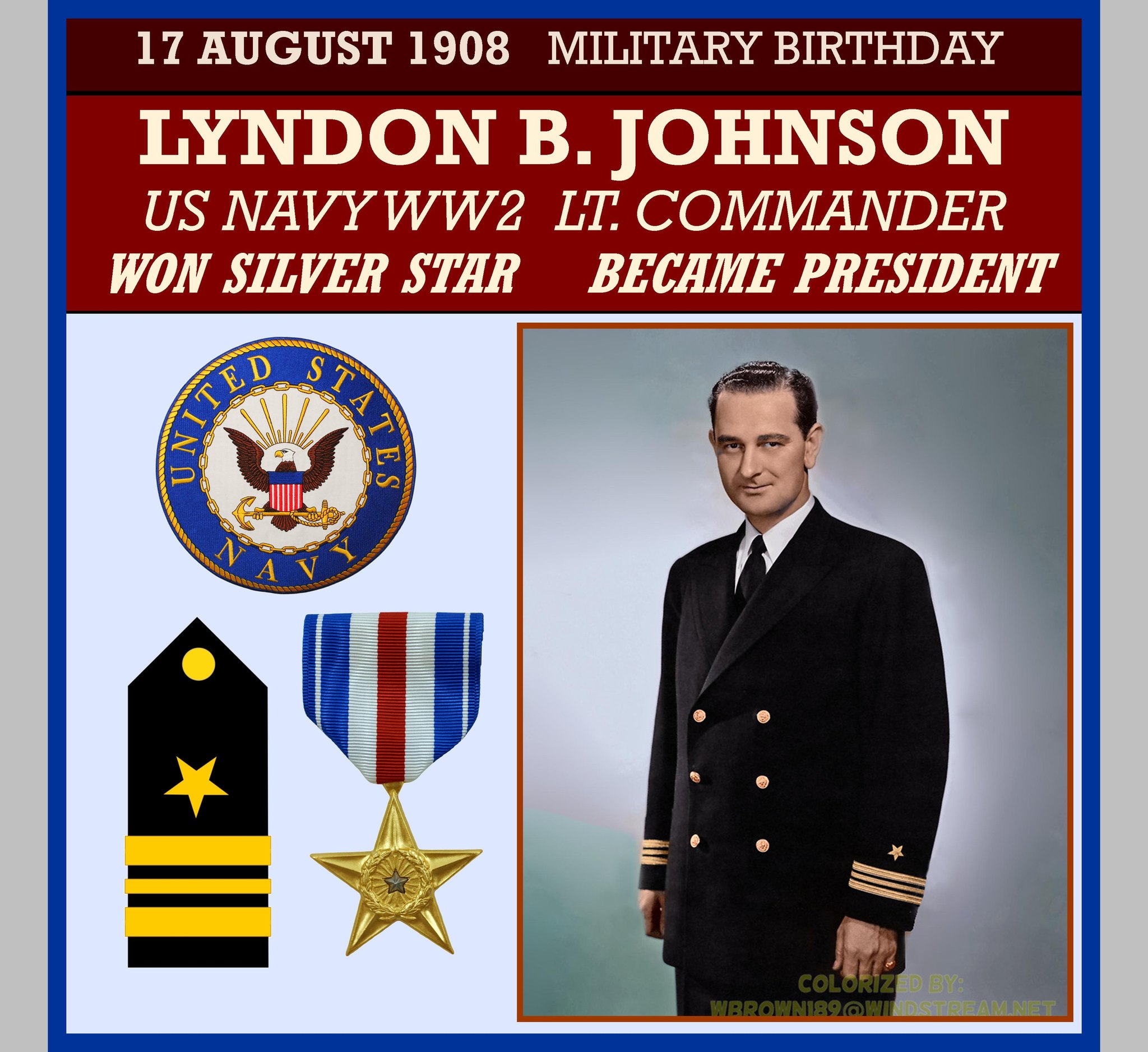
Lyndon Baines Johnson (August 27, 1908 â January 22, 1973), often referred to by his initials LBJ, was an American politician who served as the 36th president of the United States from 1963 to 1969. He had previously served as the 37th vice president from 1961 to 1963 under President John F. Kennedy, and was sworn in shortly after Kennedy’s assassination. A Democrat from Texas, Johnson also served as a U.S. representative, U.S. senator and the Senate’s majority leader. He holds the distinction of being one of the few presidents who served in all elected offices at the federal level.
Appointed Lieutenant Commander in the United States Naval Reserve on 21 June 1940, Johnson reported for active duty on 9 December 1941, after the Japanese bombed Pearl Harbor. He was ordered to the Office of the Chief of Naval Operations, Navy Department, Washington, D.C. After completing his training in Washington, Johnson proceeded to Headquarters, Twelfth Naval District, San Francisco, CA for inspection duty in the Pacific. While stationed in New Zealand and Australia, he worked as an observer of bomber missions in the South Pacific, for which he was later awarded the Army Silver Star Medal.
After President Roosevelt ordered all members of Congress in the Armed Forces to return to their legislative duties, Johnson was released from active duty under honorable conditions on 16 June 1942. In 1949 he was promoted to Commander in the Naval Reserves to date from 1 June 1948. During his time in service, Johnson was awarded the Asiatic Pacific Campaign Medal and the World War II Victory Medal.
MILITARY HISTORY SOCIETY OF ROCHESTER
ROCHESTERMILITARY.COM