MAY 21
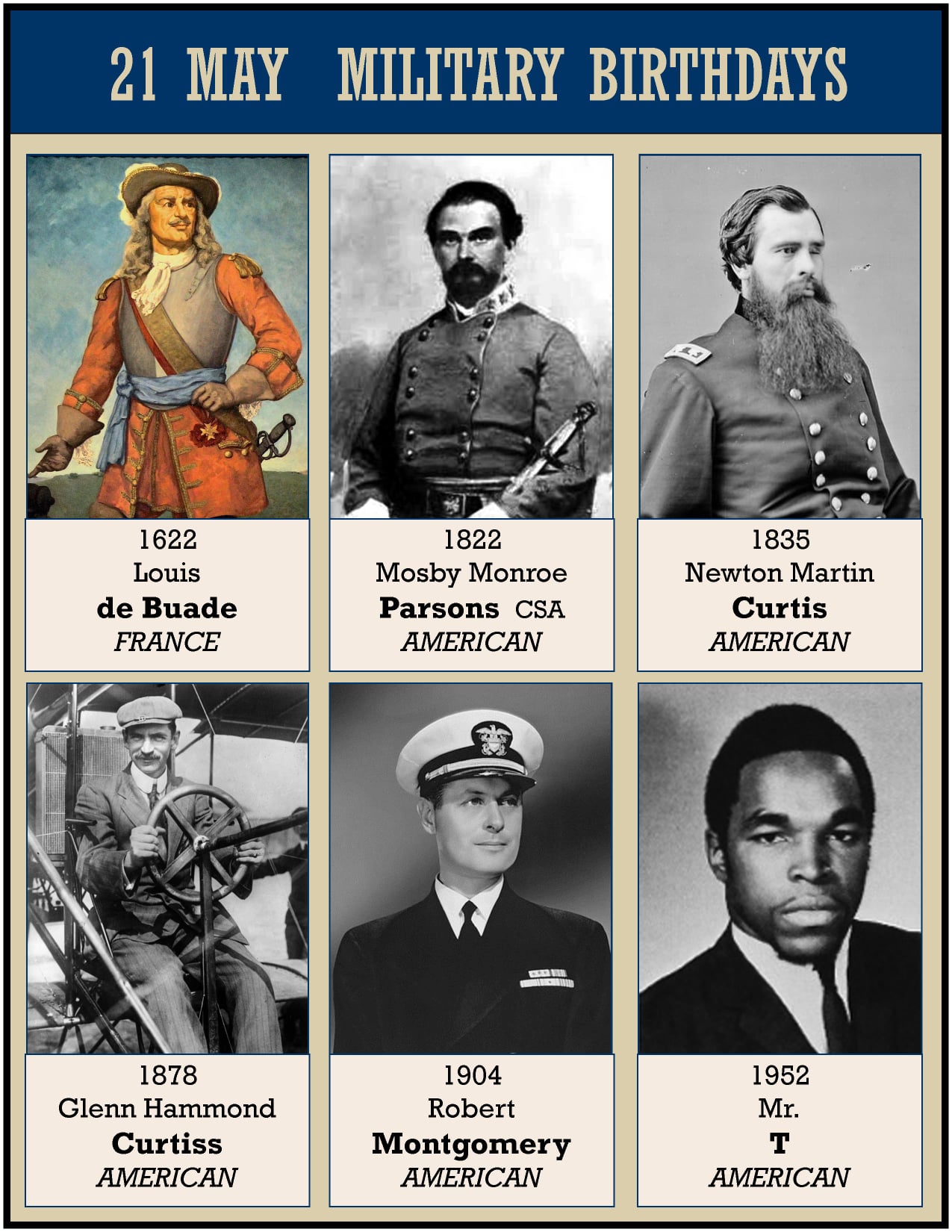
1622 Louis de Buade, Comte de Frontenac et de Palluau (21 May 1622 â 28 Nov 1698) was a French soldier, courtier, and Governor General of New France in North America from 1672 to 1682 and from 1689 to his death in 1698. He established a number of forts on the Great Lakes and engaged in a series of battles against the English and the Iroquois. In his first term, he supported the expansion of the fur trade, establishing Fort Frontenac (in what is now Kingston, Ontario) and came into conflict with the other members of the Sovereign Council over its expansion and over the corvées required to build the new forts. In particular, despite the opposition of bishop François de Laval, he supported selling brandy to the aboriginal tribes, which Laval considered a mortal sin. The conflict with the Sovereign Council led to his recall in 1682. His second term was characterised by the defence of Quebec from an English invasion during King William’s War, a successful campaign against Iroquois and English settlements that resulted in the elimination of the Iroquois threat against New France and a large expansion of the fur trade using Canadian coureurs des bois. He died before his second recall to France.
1822 Brigadier-General Mosby Monroe Parsons (May 21, 1822 â August 15, 1865) was a senior officer of the Confederate States Army who commanded infantry in the Trans-Mississippi Theater of the American Civil War. Parsons was murdered by Captain Dario Garza, at the head of a body of Mexican soldiers, on or about August 15, 1865, near China, Nuevo León, Mexico.
1835 Newton Martin Curtis (May 21, 1835 â January 8, 1910) was a Union officer during the American Civil War and a member of the United States House of Representatives from New York.
1872 Glenn Hammond Curtiss (May 21, 1878 â July 23, 1930) was an American aviation and motorcycling pioneer, and a founder of the U.S. aircraft industry. He began his career as a bicycle racer and builder before moving on to motorcycles. As early as 1904, he began to manufacture engines for airships. In 1908, Curtiss joined the Aerial Experiment Association, a pioneering research group, founded by Alexander Graham Bell at Beinn Bhreagh, Nova Scotia, to build flying machines. Curtiss won a race at the world’s first international air meet in France and made the first long-distance flight in the U.S. His contributions in designing and building aircraft led to the formation of the Curtiss Aeroplane and Motor Company, now part of Curtiss-Wright Corporation. His company built aircraft for the U.S. Army and Navy, and, during the years leading up to World War I, his experiments with seaplanes led to advances in naval aviation. Curtiss civil and military aircraft were predominant in the interwar and World War II eras.
1904 Robert Montgomery (born Henry Montgomery Jr.; May 21, 1904 â September 27, 1981) was an American film and television actor, director, and producer., in 1940 a volunteer ambulance driver in France with the American Field Service, won a Navy commission, rose to the rank of lieutenant commander, saw action in the Atlantic, Pacific, Mediterranean. After six months at Guadalcanal, he fought in the Kula Gulf Battle, commanded a destroyer during the invasion of France.
1952 Lawrence Tureaud (born May 21, 1952) ,better known as Mr. T, is an American actor, television personality, and retired bouncer, bodyguard and professional wrestler. After enlisting in the U.S. Army in 1975, Tureaud was assigned to the Military Police Corps, in which he served with distinction. Out of a cycle of 6,000 other troops, Tureaud was elected âTop Trainee of the Cycleâ in 1975. In addition, he received a letter of recommendation from his drill sergeant as well as a promotion to squad leader. A now-famous incident took place in 1976, in which Tureaudâs platoon sergeant decided to punish him for a minor infraction by having him cut down trees. The platoon sergeant, however, did not specify how many trees. Tureaud started cutting at 6:30 in the morning. By the time a major found out what was going on and superseded the order at 10:30, Tureaud, who had been cutting trees tirelessly for four hours, had already managed to fell seventy trees in a Paul-Bunyan-esque escapade.
MILITARY HISTORY SOCIETY OF ROCHESTER
ROCHESTERMILITARY.COM