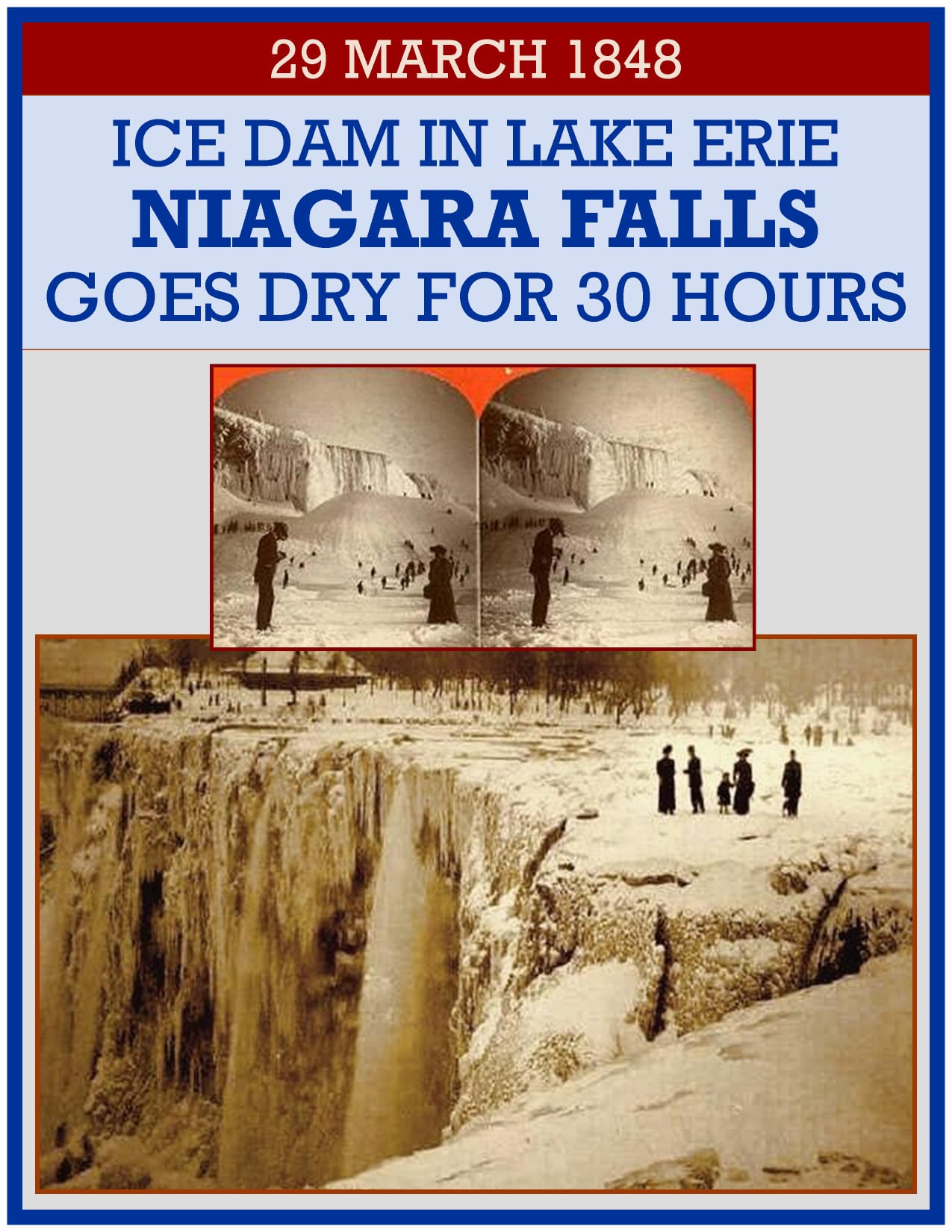
Niagara Falls gets cold every year. The average temperature in Niagara Falls in January is between 16 and 32 degrees. Naturally, it being that cold, ice floes and giant icicles form on the falls, and in the Niagara River above and below the falls, every year. The ice at the base of the falls, called the ice bridge, sometimes gets so thick that people used to build concession stands and walk to Canada on it. Itâs nothing out of the ordinary. It is not, to put it bluntly, big polar vortex news.
Despite appearances, water flows in abundance under those bridges of ice. Only once in recorded history did Niagara Falls run dry. On this day in 1848, roughly 212,000 cubic feet per second dried, to a trickle. Not dried, really, nor did it freeze. Strong southwest winds had driven massive amounts of ice to the head of Niagara River, effectively putting a cork in the bottle.
Fish flopped in the dry riverbed as, upstream, factories ground to a halt. Souvenir hunters and daredevils walked out on the dry river bed. Some even drove buggies. One unit of the United States Army cavalry paraded back and forth, across the river. Treasure hunters found artifacts from the War of 1812: muskets, bayonets, even tomahawks. At the base of the Falls, Maid of the Mist owners took the opportunity to dynamite rocks, which had endangered their boat.
That much water is not to be denied. The ice dam broke on March 31 and, by that evening, the flow was back to normal.
MILITARY HISTORY SOCIETY OF ROCHESTER
ROCHESTERMILITARY.COM