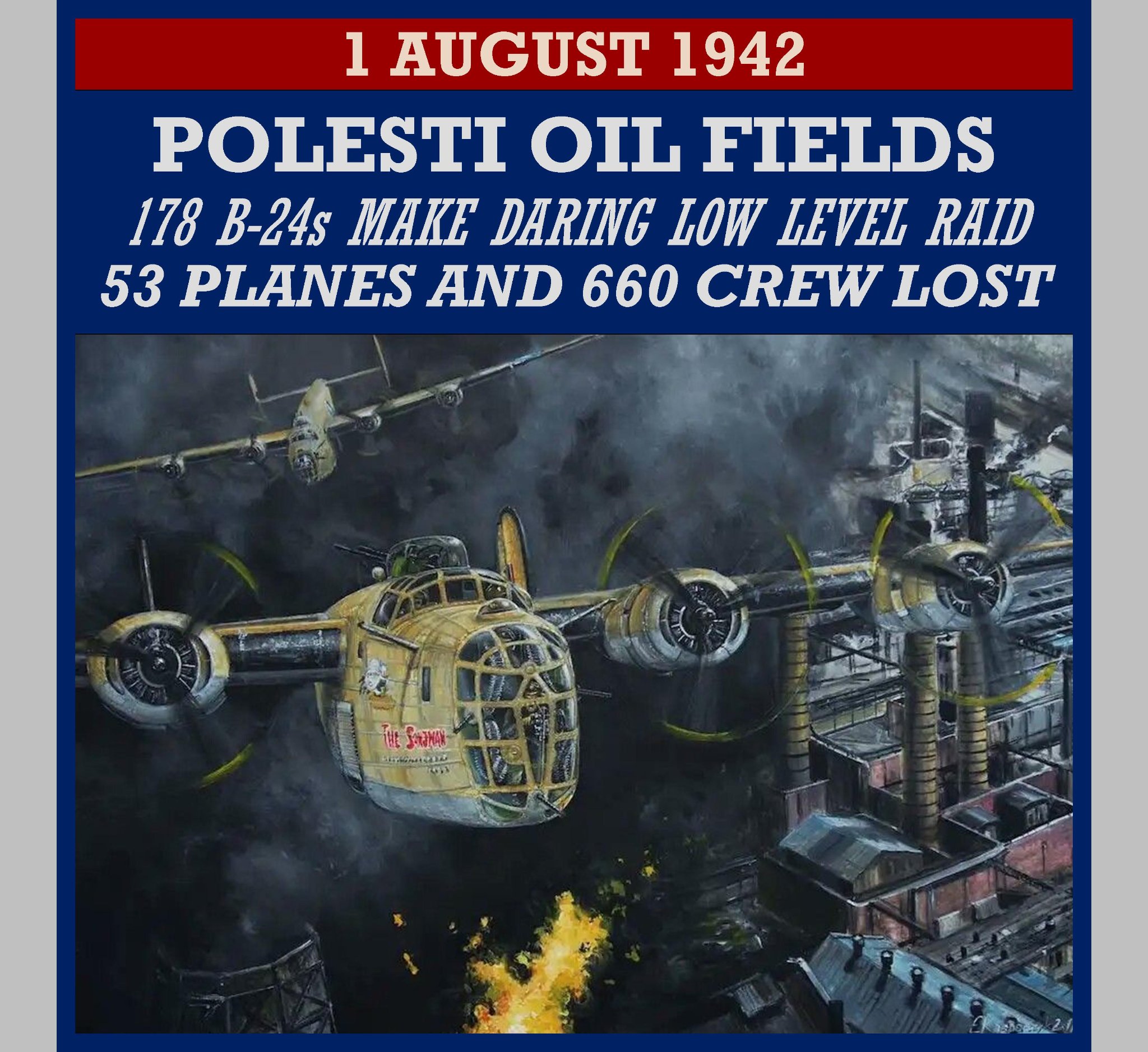
On 1 August 1943, 178 B-24 Liberator bombers flew over 1200 miles from a base in North Africa to Ploesti and staged a daring, low level attack that devestated the targets. The raid was not part of any campaign, but stood alone as a singular blow to an important component of German war-making capability. Losses were heavy and the refineries were rebuilt, but the Ploesti raid stands as a magnificent example of a bold plan, well-executed by brave crews and their extraordinary aircraft.
Operation Tidal Wave was an air attack by bombers of the United States Army Air Forces (USAAF) based in Libya on nine oil refineries around PloieÈti, Romania on 1 August 1943, during World War II. It was a strategic bombing mission and part of the “oil campaign” to deny petroleum-based fuel to the Axis powers. The mission resulted in “no curtailment of overall product output.”
This mission was one of the costliest for the USAAF in the European Theater, with 53 aircraft and 660 air crewmen lost. It was proportionally the most costly major Allied air raid of the war, and its date was later referred to as “Black Sunday”. Five Medals of Honor and 56 Distinguished Service Crosses along with numerous others awards went to Operation Tidal Wave crew members. A 1999 research report prepared for the Air War College at Maxwell Air Force Base in Alabama concluded that the mission to PloieÈti was “one of the bloodiest and most heroic missions of all time.
MILITARY HISTORY SOCIETY OF ROCHESTER
ROCHESTERMILITARY.COM