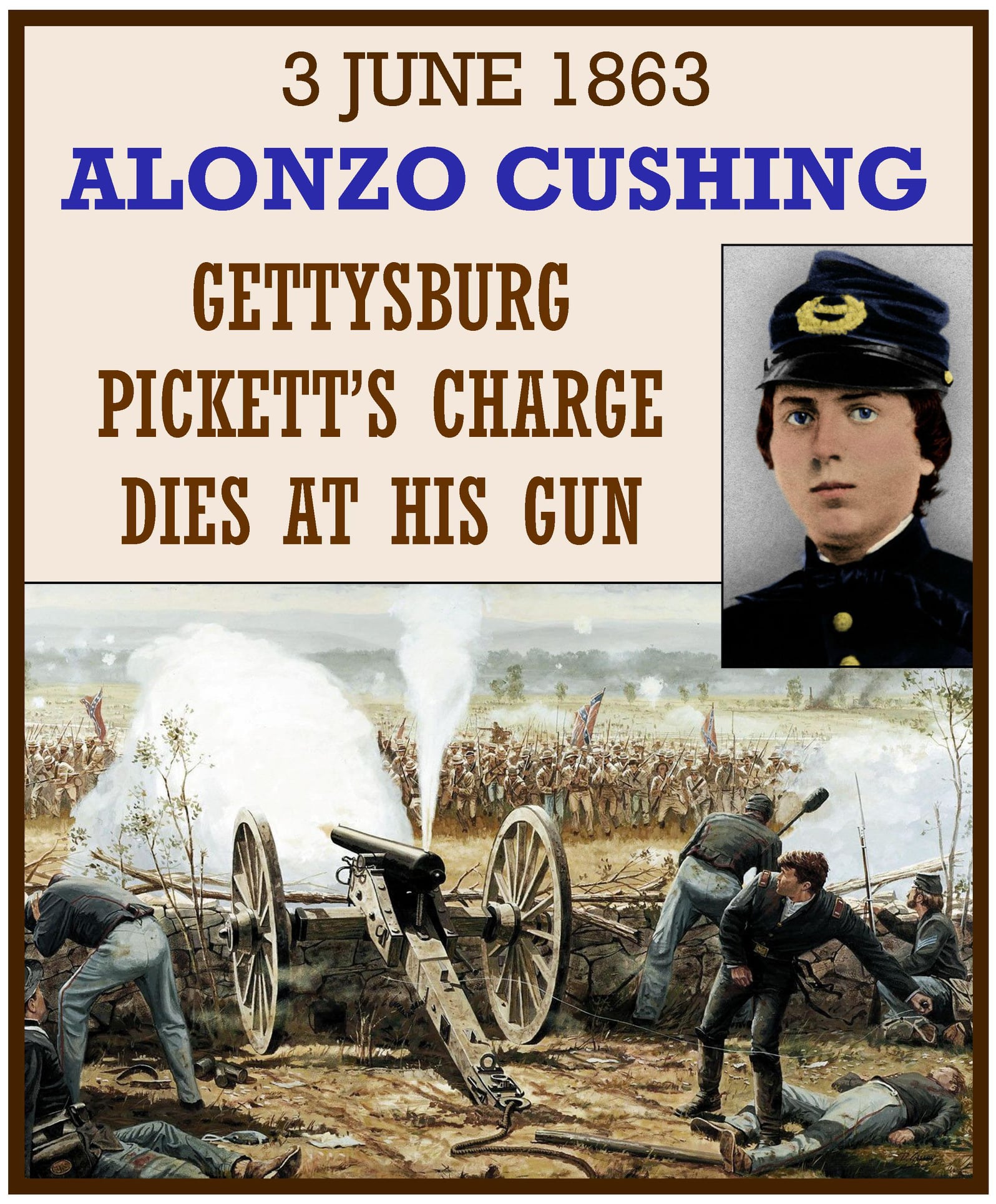
On the third day of the Battle of Gettysburg, July 3, 1863, Cushing commanded Battery A 4th U.S. Artillery, 126 men and six cannons positioned on Cemetery Ridge. In the face of Lt. Gen. James Longstreet’s Assault, Cushing’s battery took a severe pounding by Confederate artillery. Cushing and his battery stood at the apex of the assault where Confederate Maj. Gen. George Pickett intended to pierce the Union line.
Within just a few hours, all of Cushing’s officers had been killed, and all but two of his guns had been silenced. During the Confederate cannonade, he was wounded in the abdomen, as well as the right shoulder. Refusing to evacuate, despite his severe wounds, he directed the operation of his two remaining guns — firing in the face of the enemy. When the rebels were less than 100 yards from his position, Cushing was shot in the head, and died instantly. His actions materially aided the Union Army’s successful repulse of the Confederate assault. History shows that the Confederacy would be on the defensive from this point forward, and never again mount a major offensive.
Cushing was buried at West Point and posthumously promoted to lieutenant colonel. But it wasn’t until almost 150 years later that he was formally recognized for his heroics, thanks to a nearly 30-year campaign by his family to award him the Medal of Honor.
On Nov. 6, 2014, that dream was realized. President Barack Obama presented the Medal of Honor to one of Cushing’s two dozen descendants who attended the White House ceremony. Shortly after that, the Navy’s guided-missile cruiser USS Gettysburg renamed its officers’ dining hall the Cushing Wardroom in Cushing’s honor.
Alonzo grew up in Fredonia, NY.
MILITARY HISTORY SOCIETY OF ROCHESTER
ROCHESTERMILITARY.COM