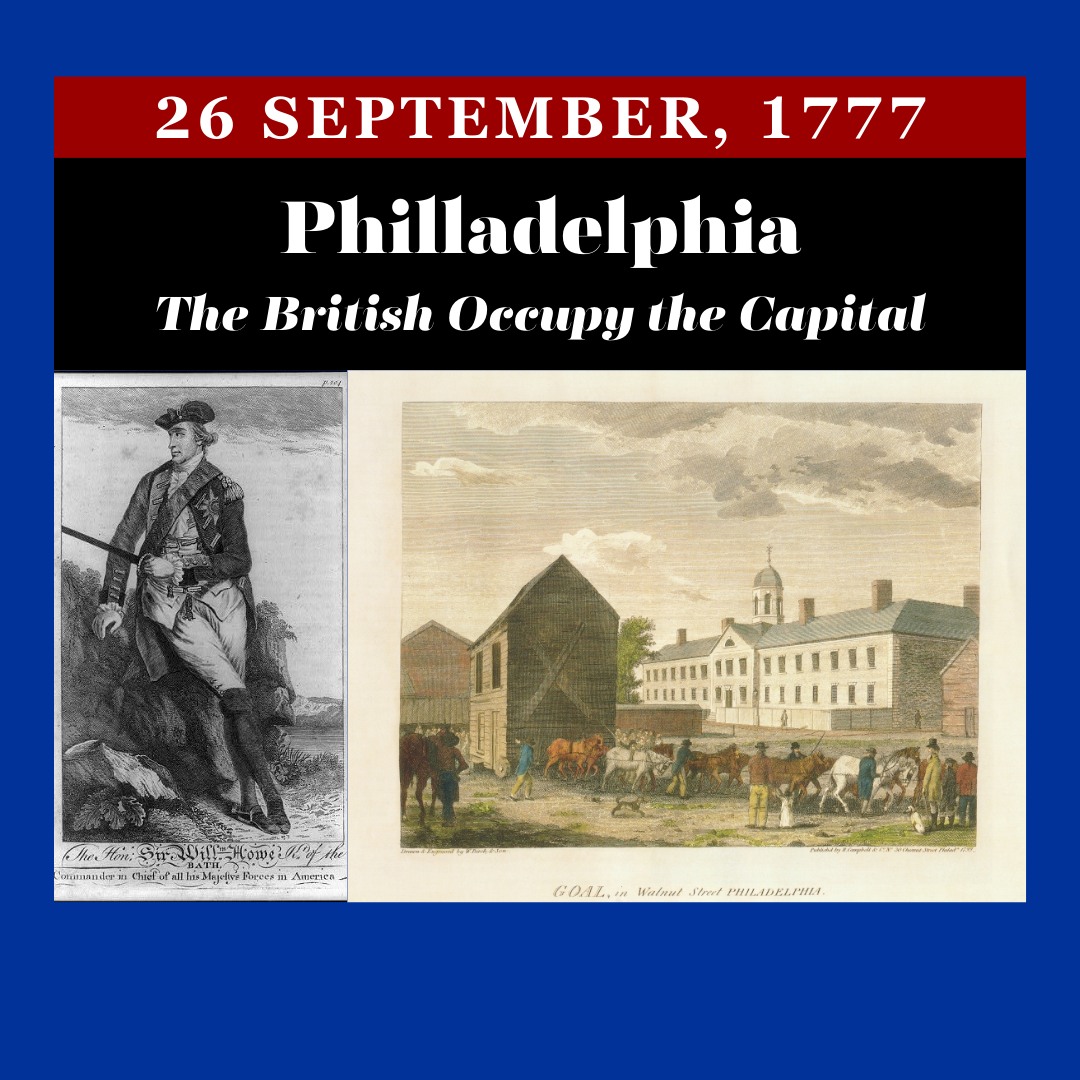
#OnThisDay September 26, 1777, the British army marched into Philadelphia, beginning an occupation that lasted until the following spring. Its arrival led patriots to flee and Loyalists to rejoice, although wartime shortages soon led to suffering for those who remained in the city. The occupation, however, led to no concrete gains, and the British abandoned the city the following June.
The occupation of Philadelphia deviated from a British plan to conquer New England in 1777, after two years of inconclusive war. To conquer New England, the British intended to send two armies into New York state. The first, headed by General John Burgoyne (1722-92), proceeded south from Canada. At the same time, forces led by General William Howe (1729-1814) would have headed north from New York City along the Hudson River. These two armies would have divided New England from the other colonies, allowing the British to invade and conquer.
Howe, to the surprise of his superiors, did not follow through on this plan. Whether from personal dislike of Burgoyne, fear of allowing General George Washington (1732-99) time to rebuild his army, or doubts about his own ability to prosecute the Hudson River campaign, he rejected the plan. Instead, with a force of about fifteen thousand English and German soldiers, he sailed south along the coast and then headed up the Chesapeake Bay toward Philadelphia. In August 1777, he landed at Head of Elk, some fifty miles from the city.
Howe set his sights on Philadelphia for a number of reasons. Philadelphia, of course, was the American capital and the meeting place of the Continental Congress. Howe also apparently hoped to draw Washington into a battle that might destroy the Continental Army once and for all. Furthermore, prominent Loyalists, including Joseph Galloway (1731-1803), had claimed that more than 75 percent of Americans in Philadelphia and the surrounding region were loyal to the crown and would welcome and aid the British.
Sir William Howe, shown in a 1780 engraving, served as commander in chief of the British Army in America from 1775 to 1778. Howe was responsible for the campaign to capture Philadelphia, having already captured New York in 1776. He successfully took Philadelphia in September 1777 and led the bombardment of Fort Mifflin and Fort Mercer later that year to open a supply line to the occupied city.
Though Howe was successful in capturing Philadelphia, he did not aid in General John Burgoyne’s invasion from Canada. Burgoyne was forced to surrender, and this victory for the Continental Army is considered a principal reason that France joined the war. Howe’s other missteps, including a near-loss in the Battle of Germantown and his failure to control looting by the British Army in Philadelphia, further exposed his weakness. He resigned from his position in May 1778, a Month before the British evacuated the city.
Did you know that the British captured and occupied our capital in Philadelphia in 1777? Share your thoughts in the comments down below! ⤵ï¸
#MHSR | Rochestermilitary.com