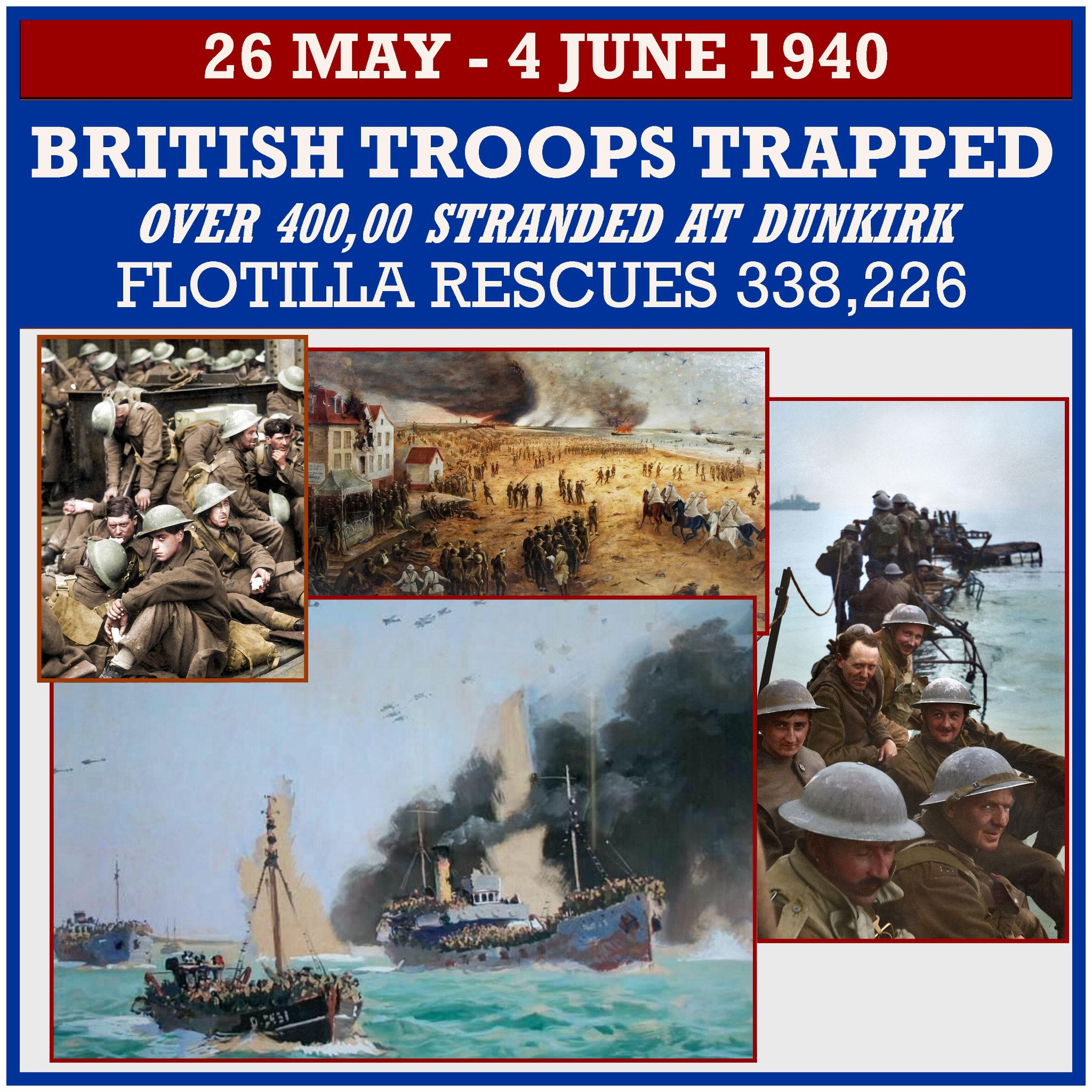
The Dunkirk evacuation, codenamed Operation Dynamo and also known as the Miracle of Dunkirk, or just Dunkirk, was the evacuation of Allied soldiers during the Second World War from the beaches and harbour of Dunkirk, in the north of France, between 26 May and 4 June 1940. The operation commenced after large numbers of Belgian, British, and French troops were cut off and surrounded by German troops during the six-week Battle of France. In a speech to the House of Commons, British Prime Minister Winston Churchill called this “a colossal military disaster”, saying “the whole root and core and brain of the British Army” had been stranded at Dunkirk and seemed about to perish or be captured. In his “We shall fight on the beaches” speech on 4 June, he hailed their rescue as a “miracle of deliverance”.
On the first day only 7,669 Allied soldiers were evacuated, but by the end of the eighth day, 338,226 had been rescued by a hastily assembled fleet of over 800 vessels. Many troops were able to embark from the harbour’s protective mole onto 39 British Royal Navy destroyers, four Royal Canadian Navy destroyers, at least three French Navy destroyers, and a variety of civilian merchant ships. Others had to wade out from the beaches, waiting for hours in shoulder-deep water. Some were ferried to the larger ships by what became known as the Little Ships of Dunkirk, a flotilla of hundreds of merchant marine boats, fishing boats, pleasure craft, yachts, and lifeboats called into service from Britain. The BEF lost 68,000 soldiers during the French campaign and had to abandon nearly all of its tanks, vehicles, and equipment. In his 4 June speech, Churchill also reminded the country that “we must be very careful not to assign to this deliverance the attributes of a victory. Wars are not won by evacuations.
MILITARY HSITORY SOCIETY OF ROCHESTER
ROCHESTERMILITARY.COM