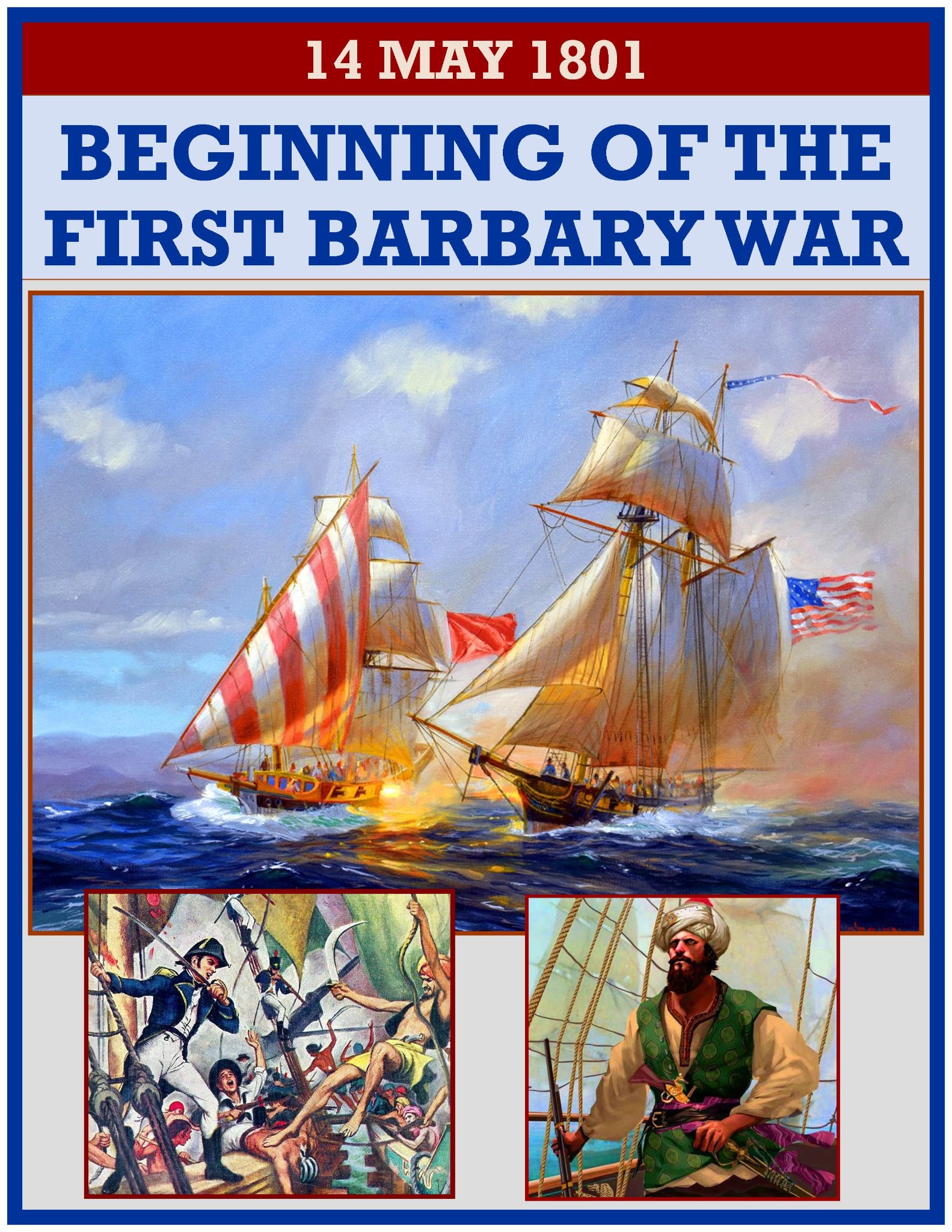
The First Barbary War (1801â1805), also known as the Tripolitan War and the Barbary Coast War, was the first of two Barbary Wars, in which the United States and Sweden fought against the four North African states known collectively as the “Barbary States”.
Barbary corsairs and crews from the quasi-independent North African Ottoman provinces of Algiers, Tunis, Tripoli, and the independent Sultanate of Morocco under the Alaouite dynasty (the Barbary Coast) were the scourge of the Mediterranean. Capturing merchant ships and enslaving or ransoming their crews provided the rulers of these nations with wealth and naval power. The Trinitarian Order, or order of “Mathurins”, had operated from France for centuries with the special mission of collecting and disbursing funds for the relief and ransom of prisoners of Mediterranean pirates. According to Robert Davis, between 1 and 1.25 million Europeans were captured by Barbary pirates and sold as slaves between the 16th and 19th centuries.
Just before Jefferson’s inauguration in 1801, Congress passed naval legislation that, among other things, provided for six frigates that “shall be officered and manned as the President of the United States may direct.” In the event of a declaration of war on the United States by the Barbary powers, these ships were to “protect our commerce and chastise their insolenceâby sinking, burning or destroying their ships and vessels wherever you shall find them.” On Jefferson’s inauguration as president in 1801, Yusuf Karamanli, the Pasha (or Bashaw) of Tripoli, demanded $225,000 (equivalent to $3.66 million in 2021) from the new administration. It was a long-standing tradition that, if a government was changed or the consular was changed, said government would have to pay ‘consular’ gifts, in either gold or in goods, usually military and naval stores. (In 1800, federal revenues totaled a little over $10 million.) Putting his long-held beliefs into practice, Jefferson refused the demand. Consequently, because of this, along with the Americans not paying the money nor the gifts as stated in the treaty signed in 1796 between Tripoli and America, in May 1801, the Pasha declared war on the United States, not through any formal written documents but in the customary Barbary manner of cutting down the flagstaff in front of the United States Consulate.
MILITARY HISTORY SOCITY OF ROCHESTER
ROCHESTERMILITARY.COM