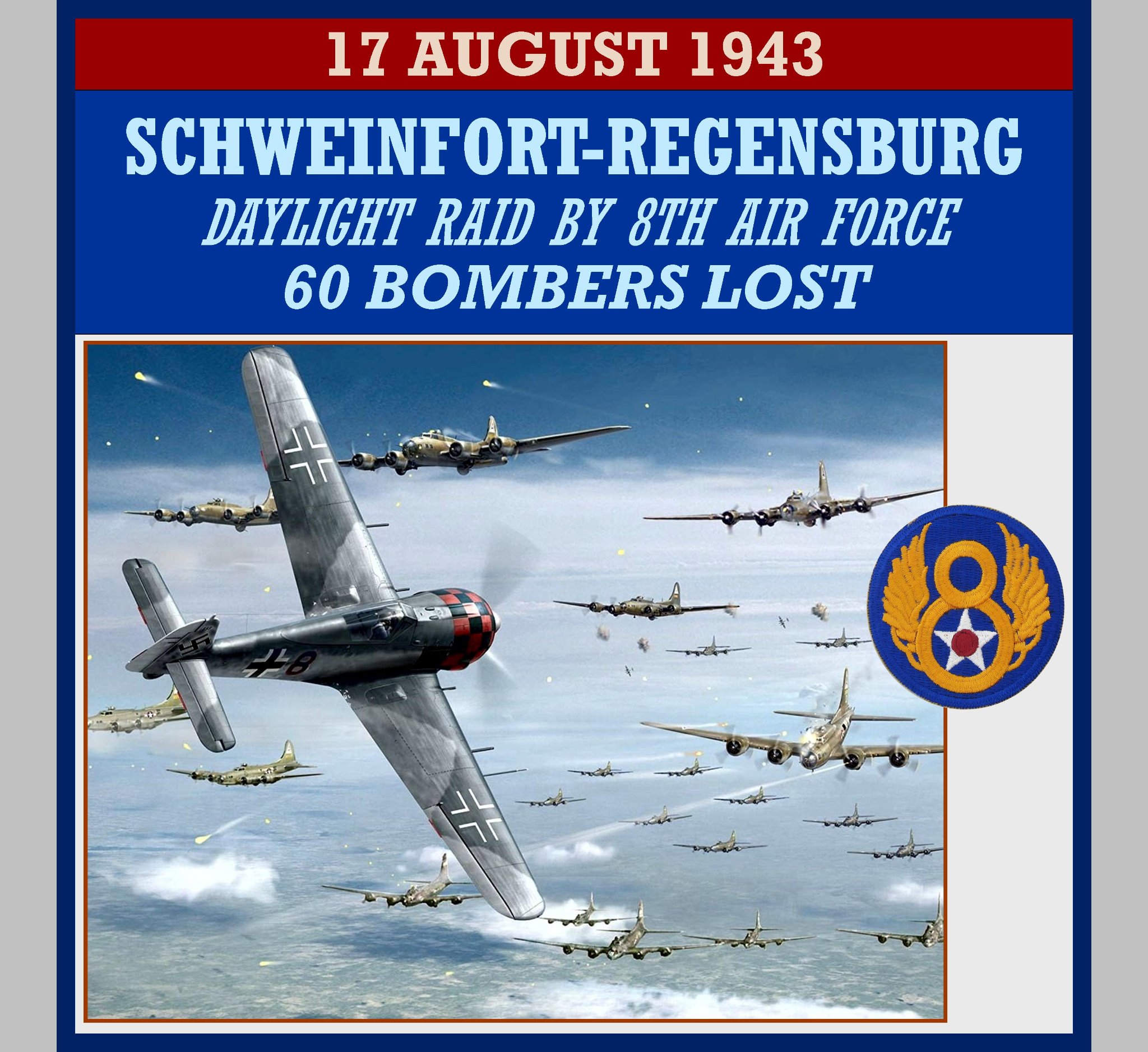
The SchweinfurtâRegensburg mission was a strategic bombing mission during World War II carried out by Boeing B-17 Flying Fortress heavy bombers of the U.S. Army Air Forces on August 17, 1943. The mission was an ambitious plan to cripple the German aircraft industry; it was also known as the “double-strike mission” because it entailed two large forces of bombers attacking separate targets in order to disperse fighter reaction by the Luftwaffe. It was also the first American “shuttle” mission, in which all or part of a mission landed at a different field and later bombed another target before returning to its base.
Mission No. 84 was a strike by 376 bombers of 16 bomb groups against German heavy industry well beyond the range of escorting fighters. The mission inflicted heavy damage on the Regensburg target, but at catastrophic loss to the force, with 60 bombers lost and many more damaged beyond economical repair. As a result, the Eighth Air Force was unable to follow up immediately with a second attack that might have seriously crippled German industry. When Schweinfurt was finally attacked again two months later, the lack of long-range fighter escort had still not been addressed and losses were even higher. As a consequence, deep penetration strategic bombing was curtailed for five months.
MILITARY HISTORY SOCIETY OF ROCHESTER
ROCHESTERMILITARY.COM