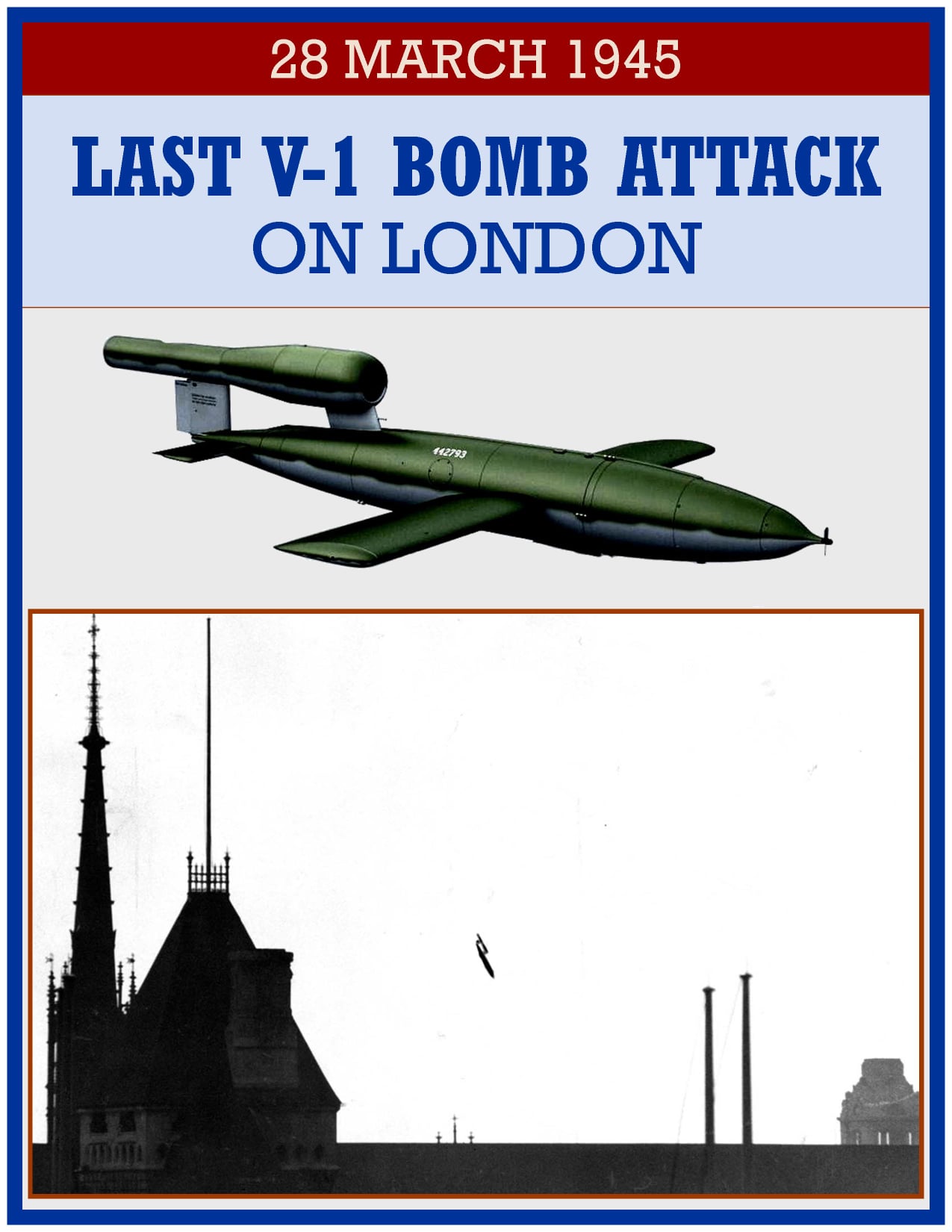
The V-1 flying bomb was developed by Germany during World War II (1939-1945) as a vengeance weapon and was an early unguided cruise missile. Tested at Peenemünde-West facility, the V-1 was the only production aircraft to utilize a pulsejet for its power plant. The first of the “V-weapons” to become operational, the V-1 flying bomb entered service in June 1944 and was used to strike London and southeastern England from launch facilities in northern France and the Low Countries. When these facilities were overrun, V-1s were fired at Allied port facilities around Antwerp, Belgium. Due to its high speed, few Allied fighters were capable of intercepting a V-1 in flight.
The first V-1 attacks occurred on June 13, 1944, when around ten of the missiles were fired towards London. V-1 attacks began in earnest two days later, inaugurating the “flying bomb blitz.” Due to the odd sound of the V-1’s engine, the British public dubbed the new weapon the “buzz bomb” and “doodlebug.” Like the V-2, the V-1 was unable to strike specific targets and was intended to be an area weapon that inspired terror in the British population. Those on the ground quickly learned that the end of a V-1’s “buzz” signaled that it was diving to the ground.
Over 30,000 V-1s were produced during the war with around 10,000 fired at targets in Britain. Of these, only 2,419 reached London, killing 6,184 people and injuring 17,981. Antwerp, a popular target, was hit by 2,448 between October 1944 and March 1945. A total of around 9,000 were fired at targets in Continental Europe. Though V-1s only struck their target 25% of the time, they proved more economical than the Luftwaffe’s bombing campaign of 1940/41. Regardless, the V-1 was largely a terror weapon and had little overall impact on the outcome of the war.
MILITARY HISTORY SOCIETY OF ROCHESTER
ROCHESTERMILITARY.COM