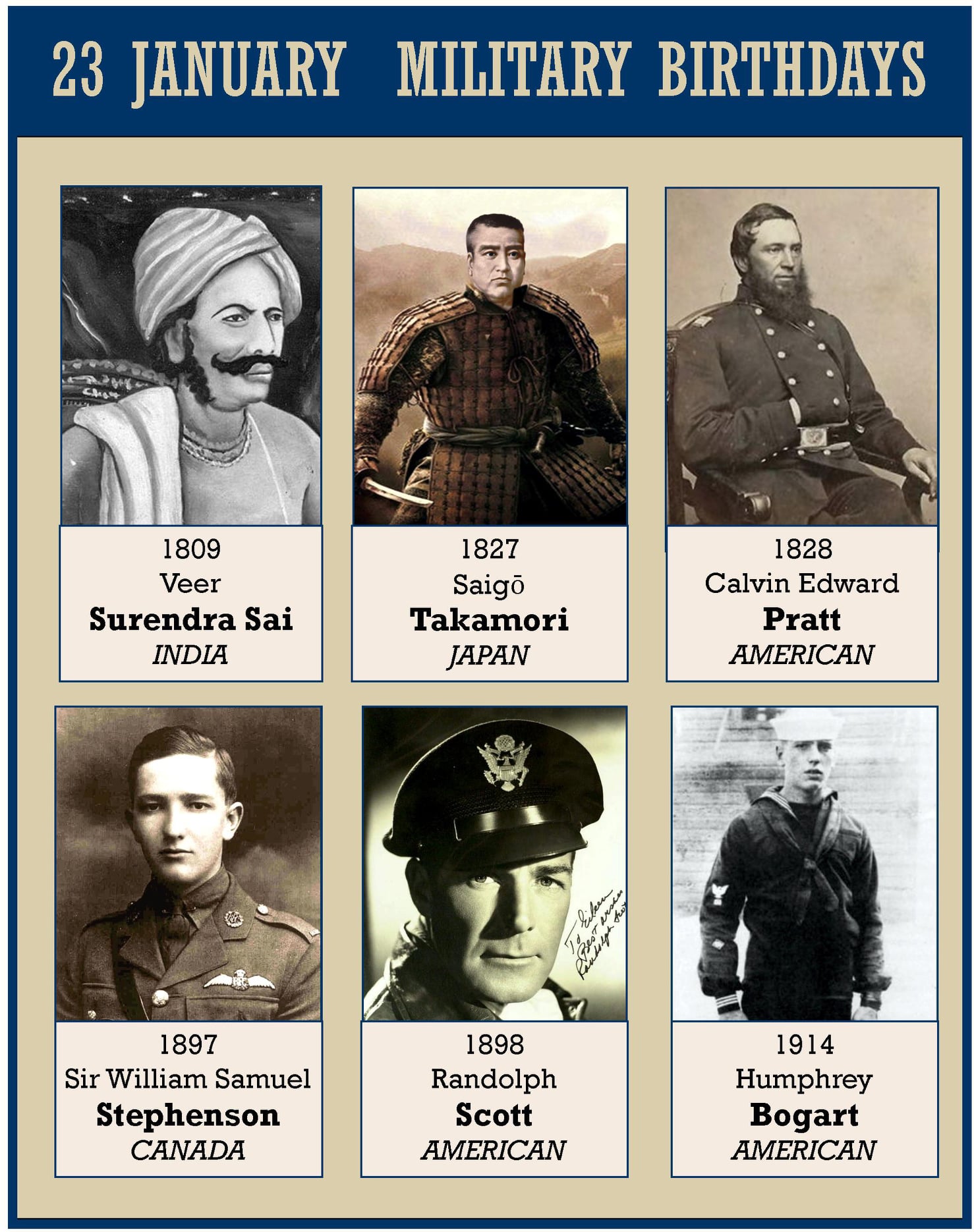
Veer Surendra Sai led a valiant struggle against the British, unfortunately, his heroism has remained unknown and unsung to most Indians. On January 23,1809, the âVeerâ was born in Khinda village, around 21 km from Sambalpur. In 1864, Sai was finally caught by the British with the help of a spy who betrayed Sai and later sent to Asirgarh fort jail. He languished in jail for 20 years during which he lost his eyesight. He breathed his last in the Jail on February 28, 1884.
SaigÅ Takamori, (born Jan. 23, 1828, Kagoshima, Kyushu, Japanâdied Sept. 24, 1877, Kagoshima), a leader in the overthrow of the Tokugawa shogunate who later rebelled against the weaknesses he saw in the Imperial government that he had helped to restore.
Calvin Edward Pratt Union Brigadier General. Born in Princeton, Massachusetts, he admitted to the bar in 1852 and practiced law in New York City. With the advent of the Civil War, he raised the 1st Regiment of New York Volunteers and was elected Colonel. He led his regiment at the first Battle of Bull Run and the second Battle…
Sir William Samuel Stephenson CC MC DFC, (23 January 1897 â 31 January 1989) the “Man Called Intrepid”, who inspired Ian Fleming to create James Bond was a Canadian soldier, airman, businessman, inventor, spymaster, and the senior representative of British Security Coordination (BSC) for the entire western hemisphere during World War I
In late July 1917, Randolph Scott and a friend, Andrew Hariss, enlisted in the service and then reported to Fort Caswell near Southport to join the Coast Artillery Corps of the North Carolina National Guard. They remained with the Coast Artillery until transferred to the 2nd Trench Mortar Battalion of the 19th Field Artillery in anticipation of overseas service in the spring of 1918. In France, the men served as artillery observers on a two-man team, a role that required them to take up positions in forward observation bomb-proofs so that they could direct artillery fire. In the bombproofs, the men faced greater exposure to threats of enemy snipers and other battlefield dangers.
Humphrey Bogart, Instead of attending a different school or looking for a civilian job, Bogart enlisted in the U.S. Navy in 1918. It’s been recorded that Bogart was a model sailor, and spent most of his career ferrying troops between the U.S. and Europe. Popular theory speculates that it was during his time in the Navy that Bogart received a scar to his lip and resulting lisp. One account claims that his ship, the USS Leviathan, was shelled by the Germans and a piece of shrapnel cut his lip.
rochestermilitary.com