APRIL 8
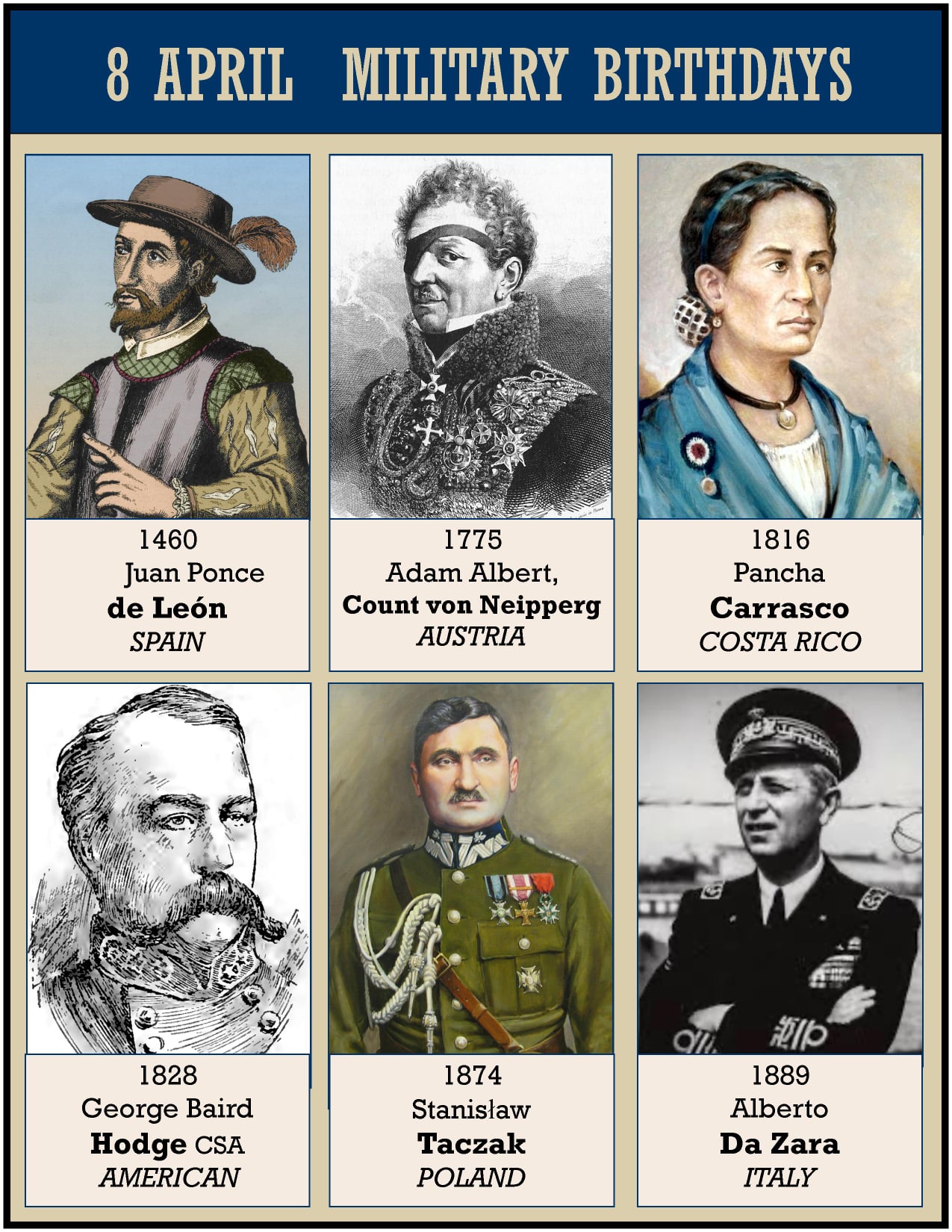
1474 Juan Ponce de León was a Spanish explorer and conquistador known for leading the first official European expedition to Florida and serving as the first governor of Puerto Rico. He was born in Santervás de Campos, Valladolid, Spain in 1474. Though little is known about his family, he was of noble birth and served in the Spanish military from a young age. He first came to the Americas as a “gentleman volunteer” with Christopher Columbus’s second expedition in 1493.
1775 Adam Albert, Count von Neipperg (8 April 1775 â 22 February 1829) was an Austrian general and statesman. He was the son of a diplomat famous for inventing a letter-copying machine, and the grandson of Count Wilhelm Reinhard von Neipperg.
1816 Pancha Carrasco (8 April 1816 â 31 December 1890), born Francisca Carrasco Jiménez, was Costa Rica’s first woman in the military. Carrasco is most famous for joining the defending forces at the Battle of Rivas in 1856 with a rifle and a pocketful of bullets. The strength and determination she showed there made her a symbol of national pride and she was later honored with a Costa Rican postage stamp,[1] a Coast Guard vessel,[2] and the creation of the “Pancha Carrasco Police Women’s Excellence Award”.
1828 George Baird Hodge (April 8, 1828 â August 1, 1892) was an attorney, Confederate politician, colonel and acting general from the Commonwealth of Kentucky. He commanded a cavalry brigade at various times and was paroled as a brigadier general at the end of the war but his appointment as a brigadier general by Confederate President Jefferson Davis was rejected twice by the Confederate States Senate.
1874 StanisÅaw Taczak (8 April 1874 â 2 March 1960, Malbork) was a Polish general. Until 8 January 1919, he was temporary commander-in-chief of the Great Poland Uprising (1918-1919). After the invasion of Poland in 1939, he was imprisoned in the Oflag VII-A Murnau POW camp in Germany.
1889 Alberto Da Zara’ (8 April 1889, Padua – 4 June 1951, Foggia) was one of the most notable admirals of the Italian Regia Marina. He joined it in 1907 and fought aboard battleships in the Italo-Turkish War and the First World War. In the inter-war years he alternated between commanding torpedo boats and cruisers and acting as a naval commander in the Aegean Sea and the Far East. He became an admiral in 1939 and after some minor commands early in the Second World War he led 7th Naval Division, playing a major part in the Battle of Pantelleria. After the Italian armistice with the Allies, he was interned on Malta.
1924 General Sir Anthony Heritage Farrar-Hockley, GBE, KCB, DSO & Bar, MC (8 April 1924 â 11 March 2006), nicknamed “Farrar the Para”, was a British Army officer and a military historian who fought a number of British conflicts. He held a number of senior commands, ending his career as Commander-in-Chief of NATO’s Allied Forces Northern Europe. Throughout his four decades of army life, he spoke plainly, and both before and after his retirement in 1982 wrote on the conflicts he had experienced and the First World War.
MILTITARY HISTORY SOCIETY OF ROCHESTER
ROCHESTERMILITARY.COM