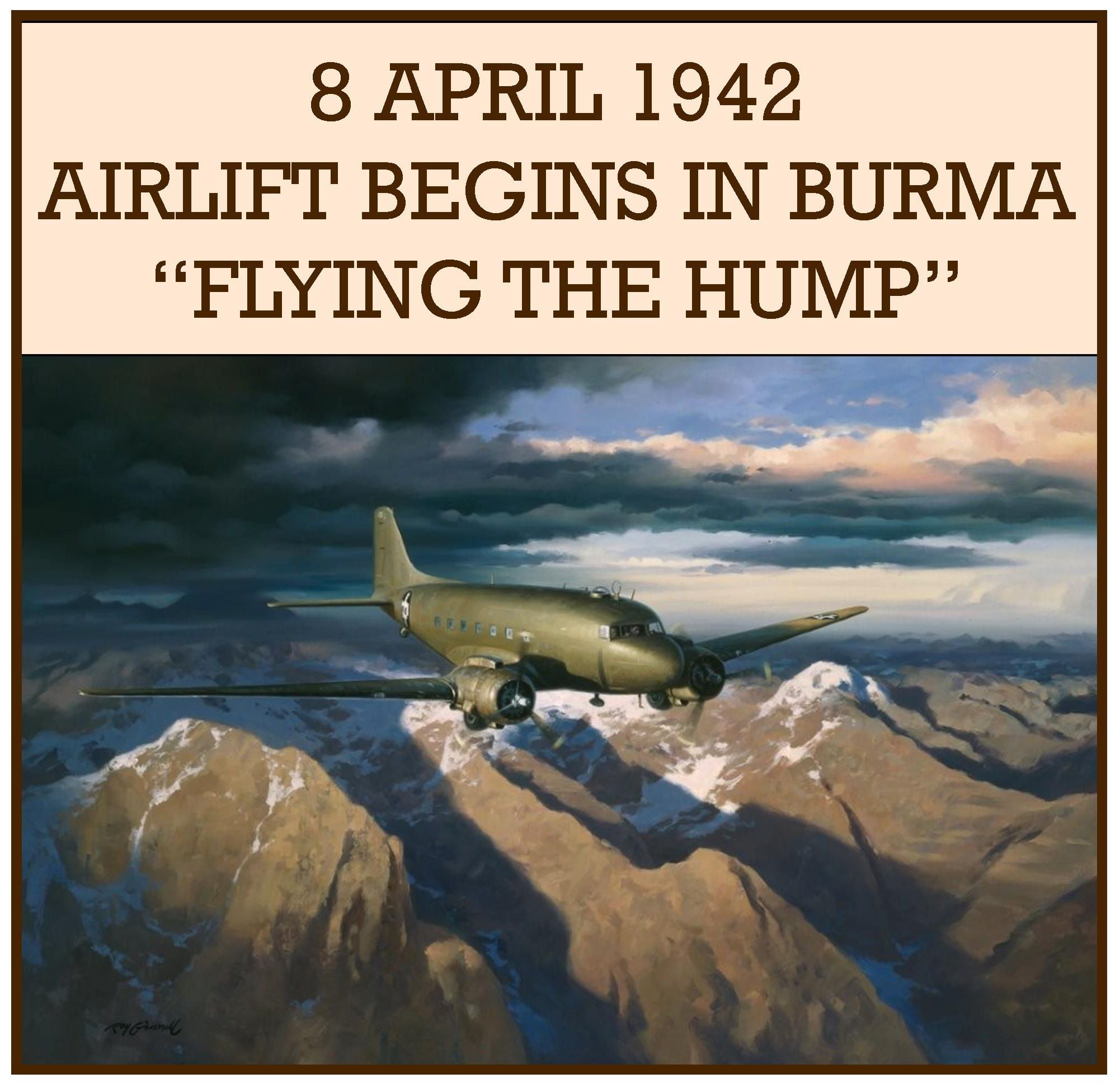
The Hump was the name given by Allied pilots in the Second World War to the eastern end of the Himalayan Mountains over which they flew military transport aircraft from India to China to resupply the Chinese war effort of Chiang Kai-shek and the units of the United States Army Air Forces (AAF) based in China. Creating an airlift presented the AAF a considerable challenge in 1942: it had no units trained or equipped for moving cargo, and no airfields existed in the China Burma India Theater (CBI) for basing the large number of transports that would be needed. Flying over the Himalayas was extremely dangerous and made more difficult by a lack of reliable charts, an absence of radio navigation aids, and a dearth of information about the weather.
The operation began in April 1942, after the Japanese blocked the Burma Road, and continued daily to August 1945, when the effort began to scale down. It procured most of its officers, men, and equipment from the AAF, augmented by British, British-Indian Army, Commonwealth forces, Burmese labor gangs and an air transport section of the Chinese National Aviation Corporation (CNAC). Final operations were flown in November 1945 to return personnel from China.
The IndiaâChina airlift delivered approximately 650,000 tons of materiel to China at great cost in men and aircraft during its 42-month history. For its efforts and sacrifices, the IndiaâChina Wing of the ATC was awarded the Presidential Unit Citation on 29 January 1944 at the personal direction of President Franklin D. Roosevelt, the first such award made to a non-combat organization.
MILITARY HISTORY SOCIETY OF ROCHESTER
ROCHESTERMILITARY.COM