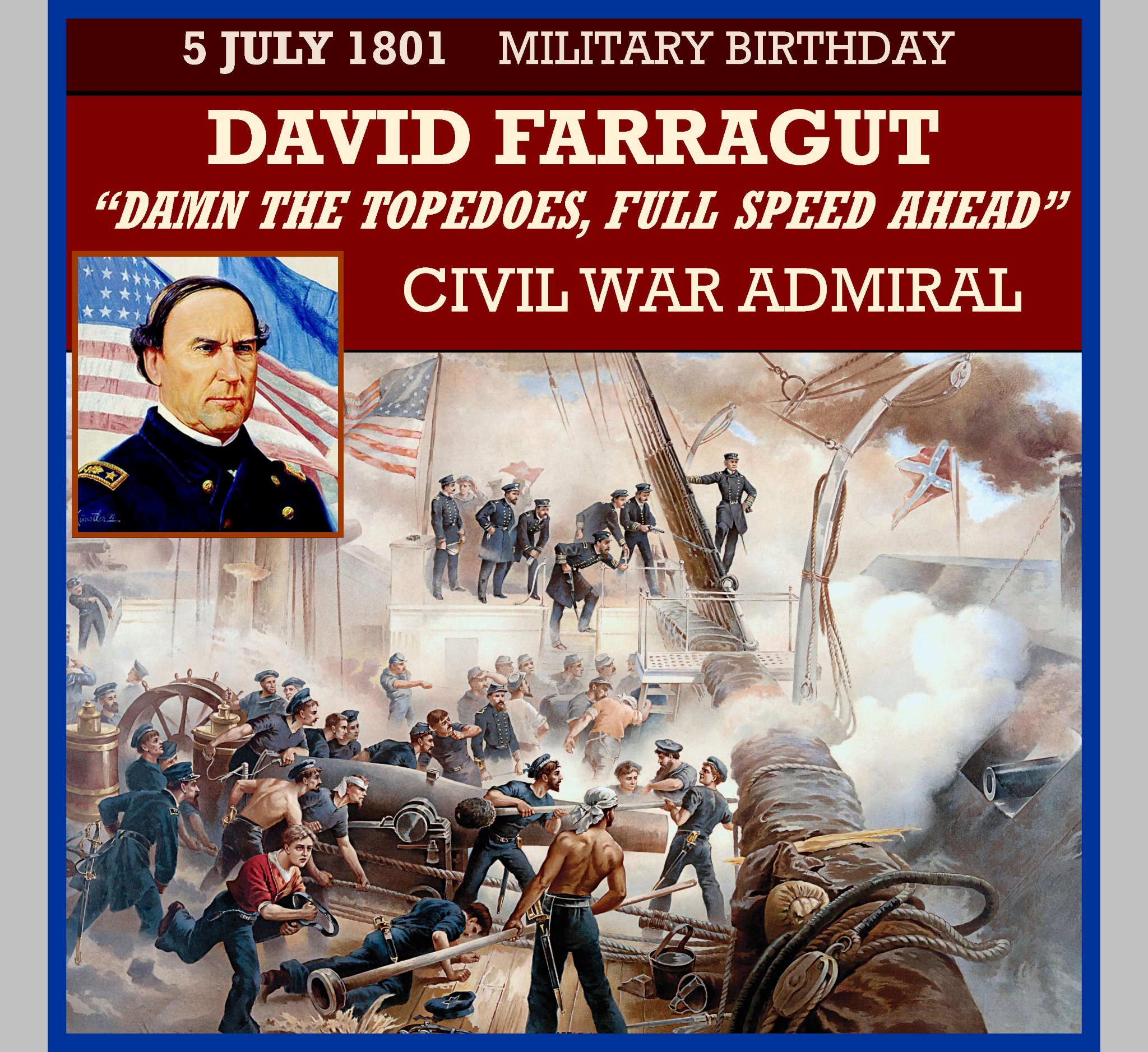
David Glasgow Farragut (July 5, 1801 â August 14, 1870) was a flag officer of the United States Navy during the American Civil War. He was the first rear admiral, vice admiral, and admiral in the United States Navy. He is remembered for his order at the Battle of Mobile Bay, usually paraphrased as “Damn the torpedoes, full speed ahead” in U.S. Navy tradition.
Farragut’s naval career began when he was added to the U.S. Navy’s rolls with the rank of boy in the spring of 1810. He was 11 years old when, during the War of 1812, he was given the assignment to bring a ship captured by the Essex safely to port. He was wounded and captured while serving on the Essex during the engagement at ValparaÃso Bay, Chile, against the British on March 28, 1814.
On August 5, 1864, Farragut won a great victory in the Battle of Mobile Bay. Mobile, Alabama, was then the Confederacy’s last major open port on the Gulf of Mexico. The bay was heavily mined (tethered naval mines were then known as “torpedoes”). Farragut ordered his fleet to charge the bay. When the monitor USS Tecumseh struck a mine and sank, the others began to pull back.
From his high perch, where he was lashed to the rigging of his flagship, USS Hartford, Farragut could see the ships pulling back. “What’s the trouble?” he shouted through a trumpet to USS Brooklyn. “Torpedoes”, was the shouted reply. “Damn the torpedoes.”, said Farragut, “Four bells, Captain Drayton, go ahead, full speed.” The bulk of the fleet succeeded in entering the bay. Farragut triumphed over the opposition of heavy batteries in Fort Morgan and Fort Gaines to defeat the squadron of Admiral Franklin Buchanan.
MILITARY HISTORY SOCIETY OF ROCHESTER
ROCHESTERMILITARY.COM