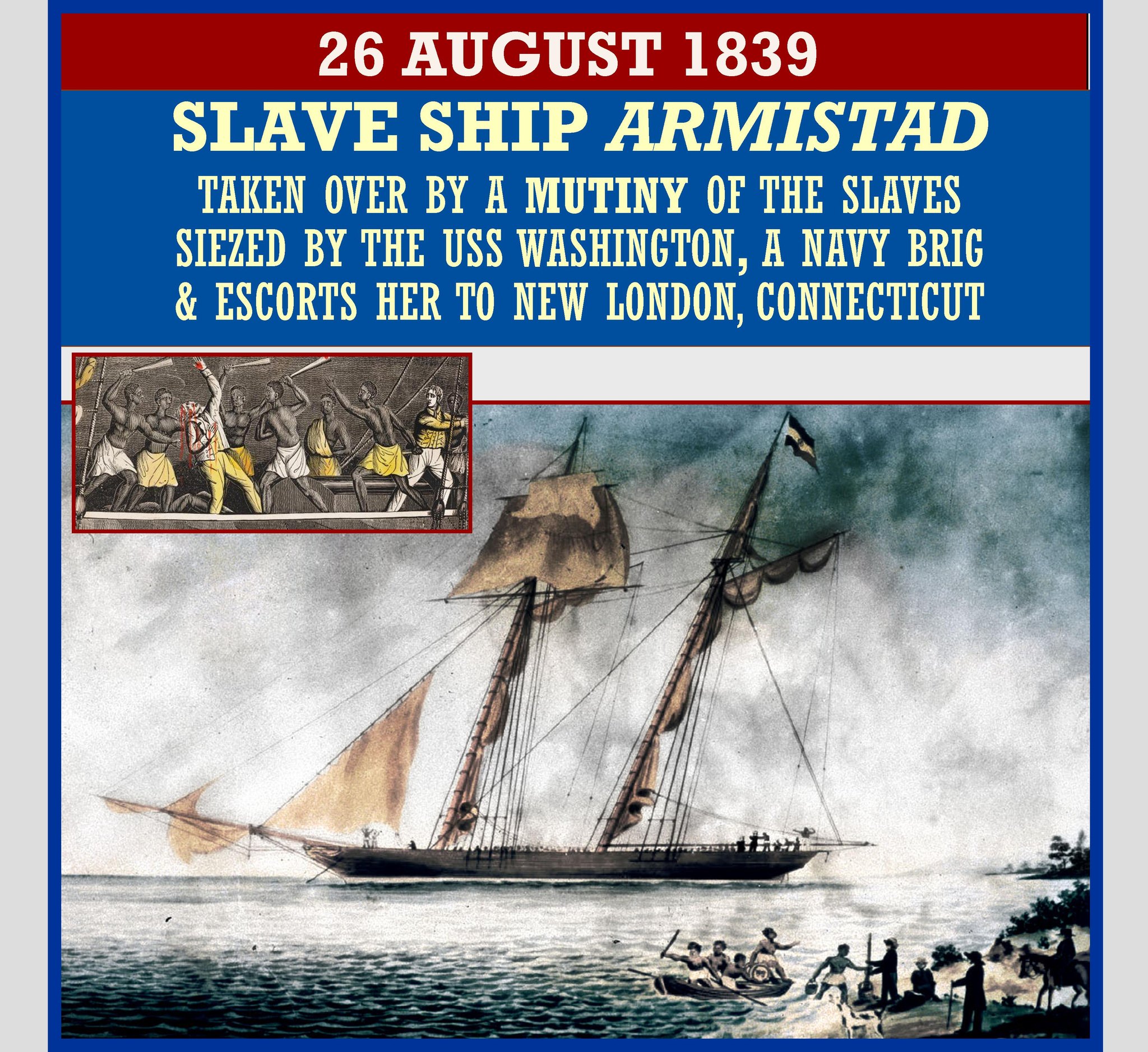
On June 28, 1839, 53 people recently captured in Africa left Havana, Cuba, aboard the Amistad schooner for a sugar plantation at Puerto Principe, Cuba. Three days later, Sengbe Pieh, a Membe African known as Cinque, freed himself and the other enslaved people and planned a mutiny. Early in the morning of July 2, in the midst of a storm, the enslaved people rose up against their captors and, using sugar-cane knives found in the hold, killed the captain of the vessel and a crewmember. Two other crewmembers were either thrown overboard or escaped, and Jose Ruiz and Pedro Montes, the two Cubans who had purchased the enslaved people, were captured. Cinque ordered the Cubans to sail the Amistad east back to Africa. During the day, Ruiz and Montes complied, but at night they would turn the vessel in a northerly direction, toward U.S. waters. After almost nearly two difficult months at sea, during which time more than a dozen Africans perished, what became known as the âblack schoonerâ was first spotted by American vessels.
On August 26, the USS Washington, a U.S. Navy brig, seized the Amistad off the coast of Long Island and escorted it to New London, Connecticut. Ruiz and Montes were freed, and the Africans were imprisoned pending an investigation of the Amistad revolt. The two Cubans demanded the return of their supposedly Cuban-born enslaved workers, while the Spanish government called for the Africansâ extradition to Cuba to stand trial for piracy and murder. In opposition to both groups, American abolitionists advocated the return of the illegally bought people to Africa.
MILITARY HISTORY SOCIETY OF ROCHESTER
ROCHESTERMILITARY.COM