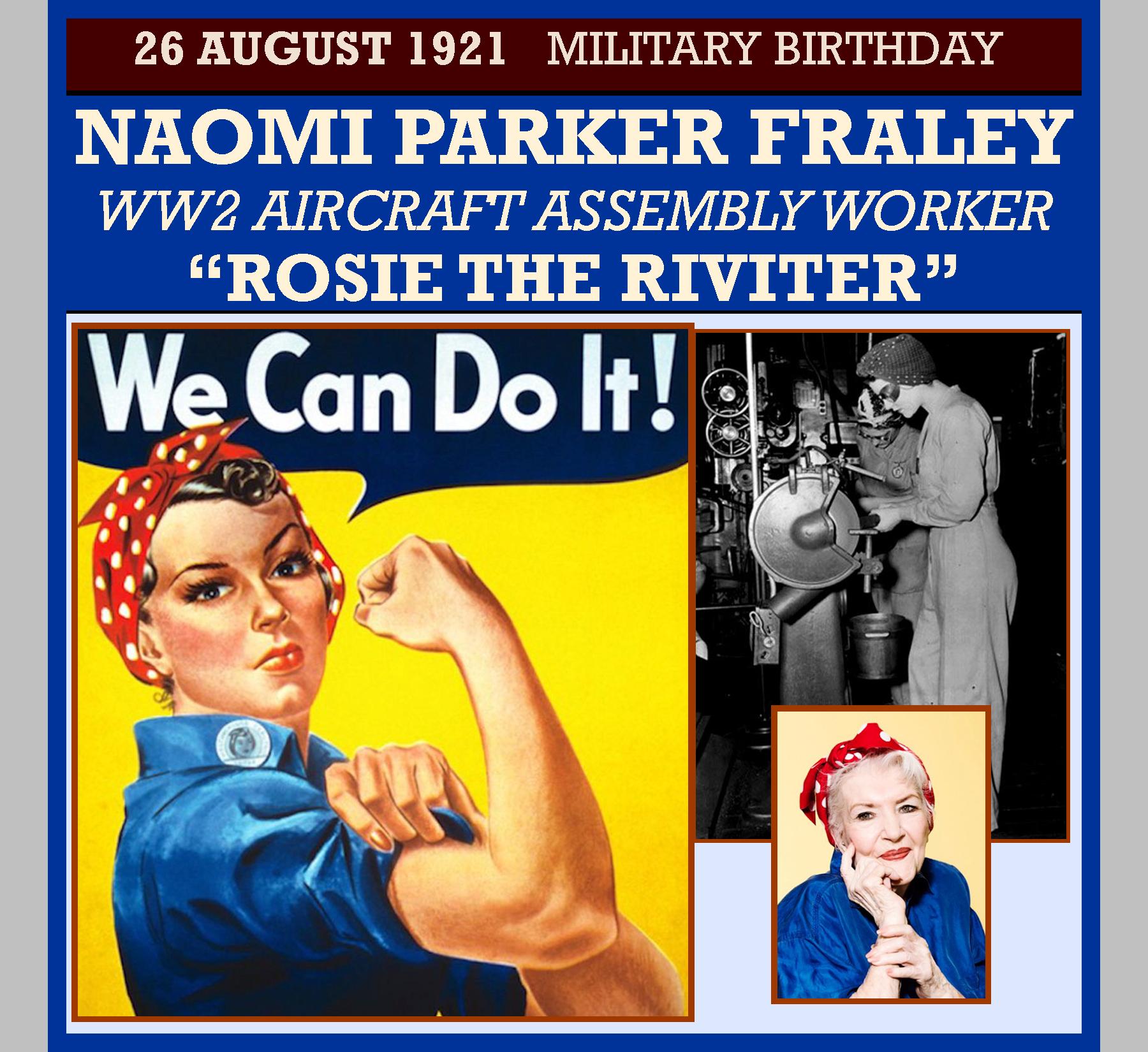
Rosie the Riveter was an allegorical cultural icon of World War II, representing the women who worked in factories and shipyards during World War II, many of whom produced munitions and war supplies. These women sometimes took entirely new jobs replacing the male workers who joined the military. Rosie the Riveter is used as a symbol of American feminism and women’s economic advantage. Similar images of women war workers appeared in other countries such as Britain and Australia. The idea of Rosie the Riveter originated in a song written in 1942 by Redd Evans and John Jacob Loeb. Images of women workers were widespread in the media in formats such as government posters, and commercial advertising was heavily used by the government to encourage women to volunteer for wartime service in factories. Rosie the Riveter became the subject and title of a Hollywood film in 1944.
Naomi Fern Parker Fraley (August 26, 1921 â January 20, 2018) was an American war worker who is now considered the most likely model for the iconic “We Can Do It!” poster. During World War II, she worked on aircraft assembly at the Naval Air Station Alameda. She was photographed operating a machine tool and this widely used photograph was thought to be an inspiration for the poster. Geraldine Hoff Doyle was initially credited as the subject but research by a professor at Seton Hall University set the record straight.
MILITARY HISTORY SOCIETY OF ROCHESTER
ROCHESTERMILITARY.COM